

How to Master Law Firm Budget Tracking in 2026
Small firm attorneys lose real income to budget surprises. Master law firm budget tracking in 2026 and keep more of what your cases earn.

Your bank balance is not a budget. Here is why small firm attorneys keep losing money between the work they do and the cash they collect, and what to track before the damage shows up.
Checking your bank balance on a Friday afternoon is not budgeting. It is a snapshot of what already happened, and for most solo and small firm attorneys, that distinction costs real money every quarter. The common assumption is that cash flow surprises are just part of running a small law firm, and that there is no reliable way to plan when income swings this wildly. According to LendingTree, 22.1% of new U.S. businesses close within their first year of operation, and the pattern behind most of those closures is financial mismanagement, specifically the kind that reactive habits cannot catch in time.
Budget Neglect Is a Personal Income ProblemLaw firm budget neglect is a personal income problem. When a small firm runs without a live budget, every unplanned expense comes out of one place: the attorney-owner's draw.

There is no abstract corporate P&L absorbing the hit. A slow collections month, an unexpected malpractice premium adjustment, a software renewal that slipped the calendar, each one lands directly on personal income. Solo practitioners who track their finances through gut feel and periodic bank checks often discover the damage only after it has already happened.
The Two Financial Layers Every Law Firm Must TrackLaw firms earn revenue in one period and collect it in another, and the gap between those two events is where profitability quietly erodes. A solo practitioner can invoice $18,000 in a quarter and collect $11,000, not because the work was bad, but because accounts receivable aging was never tracked. Without a budget that monitors 30-, 60-, and 90-day receivable buckets, that $7,000 shortfall arrives as a surprise rather than a signal seen weeks earlier. Every law firm must track two distinct financial layers:
- Operational overhead, which covers rent, payroll, malpractice insurance, software subscriptions, and bar dues.
Key takeaways
- Checking your bank balance on a Friday is not budgeting; it's a record of what already happened, and for most small firms, that distinction costs real money every quarter.
- Three structural failures quietly kill small firm profitability: irregular revenue forecasting, untracked overhead creep, and a budget that stopped getting updated in February.
- Multiplying your hourly rate by hoped-for hours produces a number, not a plan; utilization rate and realization rate compound between 'hours worked' and 'money deposited,' and skipping them makes your forecast wrong from line one.
- The Rule of Thirds framework allocates roughly one-third of firm revenue to overhead, giving every expense category, rent, malpractice insurance, software, bar dues, CLE, a structural anchor before the first dollar is spent.
- A monthly actuals-versus-budget review catches more than misclassified expenses; it surfaces the receivable that has been quietly aging for sixty days before it becomes a $4,200 collection problem.
- Software is never the constraint; the process underneath it is. Firms that switch platforms mid-year and still face Q4 cash flow surprises skipped that step.
- OpenCase closes the work-product gap that practice management software cannot: where a budget report shows only hours logged, OpenCase delivers AI-powered legal research grounded in real law, so the time billed actually reflects output worth billing.
Common Law Firm Budgeting Challenges: and the Three That Actually Kill Profitability
Three structural failures quietly drain small law firm profitability every year, and most attorneys never connect them to each other. They surface as a slow month, a surprise expense, or a budget spreadsheet that stopped getting updated in February, each one easy to dismiss as ordinary friction. But according to LeanLaw, 82% of failed small businesses cite poor cash flow management, which means the pattern is far too common to be a coincidence of bad luck or difficult clients. The assumption that income swings are unavoidable, that there is no reliable way to plan when revenue moves this unpredictably, is itself one of the reasons the failures compound.
82% of law firms fail due to poor cash flow management

Contingency and Hourly Billing Cycles That Derail Revenue Projections
Contingency matters can run twelve to eighteen months before a dollar arrives. Hourly billing produces invoices, but collection lags, slow-paying clients, and retainer draws that don't match actual work completed make the timing of cash inflows genuinely hard to predict. As LeanLaw notes, revenue unpredictability from these billing cycles makes income projection feel like guesswork, so firms stop projecting altogether. Without a revenue baseline, every expense decision is made against an invisible number.
Part of what makes projection feel impossible is the sheer volume of case research that has to happen before a matter's timeline, and therefore its billing arc, becomes clear. Attorneys at small firms who need to find the statute, regulation, or court rule that governs a situation, or distill a long opinion down to the holding that actually matters, are spending unbillable hours doing work that delays the moment they can even estimate when a contingency file will resolve. OpenCase searches across 100+ legal databases, including Cornell LII, daily PACER updates, and the Federal Register, so that a research task that once consumed an afternoon can be completed in minutes. When research moves faster, case timelines become less opaque, and revenue projections become less of a guess.
Underestimating Fixed Overhead by Ignoring Non-Billable Time
Fixed overhead is the category attorneys most consistently underestimate. Rent, payroll, and malpractice insurance get budgeted. Legal research subscriptions, bar dues, CLE fees, and software renewals often do not, until a year-end reconciliation surfaces a gap that should have been visible in January.
Small gaps in revenue tracking compound into significant losses that firms rarely trace back to their origin. The deeper problem is non-billable time, which is never counted as a cost even though it has one. Every hour an attorney spends reformatting a document between Microsoft Word, Google Docs, Google Drive, and Dropbox, or manually pulling a filing from PACER into a brief, is an hour that does not appear on any invoice but absolutely appears on the payroll. OpenCase integrates directly with Microsoft Word, Google Docs, Outlook, Google Drive, and Dropbox, so that the document drafting and file analysis work that follows research happens inside tools attorneys already use, without manual transfer.
That friction reduction is a direct offset to the hidden overhead cost of non-billable administrative time that LeanLaw identifies as one of the primary reasons small firm budgets silently erode. When a skeptical partner asks whether AI-assisted research can actually be trusted in this firm, the answer is grounded in the same authoritative sources, Cornell LII, PACER, the Federal Register, that the firm would consult manually, delivered through a workflow that removes the overhead rather than adding to it.
Projecting Law Firm Revenue Realistically - Core Metrics Every Firm Must Track
Multiply your hourly rate by your hoped-for hours, and you get a number that feels like a plan. It isn't. Two compounding losses sit between "hours worked" and "money deposited," and skipping them makes your forecast structurally wrong from the first line.

Utilization Rate - The First Number That Separates a Real Forecast from a Wish
Utilization rate is the core revenue metric law firms should anchor their projections to: divide billable hours by total hours worked, and the result tells you what fraction of your working day actually converts to invoiceable time. According to Smokeball's benchmarking report, the industry minimum target is 70%, with top-performing attorneys reaching 75% or higher. A firm running at 65% loses roughly one billable hour for every three hours worked before a single invoice goes out.
Key takeaway: A firm running at 65% utilization loses roughly one billable hour for every three hours worked, before a single invoice goes out.
One category of loss that rarely gets named is unbillable research time. Hours spent verifying case law, confirming a statute is still current, or checking whether a cited opinion actually says what it claims cannot be invoiced. Those hours come straight out of the utilization rate denominator.
Attorneys who compress that unbillable research window convert more of each working hour into a billable entry, which directly lifts the utilization rate that anchors every projection in this section.
Realization Rate - Why the Invoice Total Is Never the Revenue Total
Realization rate answers a different question: of everything you billed, how much did you actually collect? Realization rate captures the percentage of billed work that converts to collected cash, and for many firms, that number runs meaningfully below 100%.
The critical and underappreciated insight here is that realization rate volatility by practice area, not aggregate revenue, is the true diagnostic lever for law firm cash flow predictability. Because billing models fundamentally change which metrics matter (contingency firms must weight case-outcome probability; flat-fee firms must monitor scope creep), a single firm-wide realization rate obscures the exact case types manufacturing cash flow chaos, while a per-practice-area breakdown enables surgical intake decisions that stabilize monthly receipts before a shortfall ever appears in the bank account. Tracking collections per timekeeper alongside realization rate sharpens this picture further, because it surfaces whether a shortfall is a billing problem, a collections problem, or both.
Consider a firm that discovers its blended realization rate is well below target. That figure alone tells you almost nothing actionable. It could reflect one practice area performing strongly while masking another that is severely underperforming.
Identifying and Categorizing Law Firm Expenses - What Actually Goes in a Law Firm Budget
Before you can track a budget, you need to know what belongs in one and why each category behaves the way it does. This section breaks down the full overhead stack law firms typically carry, draws a hard line between fixed and variable costs, and explains why that distinction is a practical decision tool rather than a bookkeeping formality. Getting the categorization right is the prerequisite for everything else, including knowing whether your spending is actually on track or just looks that way.

The Full Overhead Stack - Every Expense Category That Belongs in a Law Firm Budget
Law firm operational overhead includes rent, non-attorney payroll, malpractice insurance, software subscriptions, bar dues, CLE costs, and legal research tools. Across the market, the Rule of Thirds framework allocates roughly one-third of firm revenue to overhead, so it serves as the structural anchor for any reliable budget. That benchmark is useful precisely because it gives you a ceiling to test against: if your overhead third is running at 40% of revenue, something in the stack is either miscategorized or out of control.
One commonly underestimated line item is malpractice insurance. Solo practitioners pay varying amounts annually for a basic policy, with premiums climbing sharply by practice area and claims history. Budget for the renewal figure, not last year's quote.
Fixed vs. Variable - Why the Split Is a Decision Tool, Not an Accounting Formality
Fixed costs (rent, insurance premiums, base salaries) are obligations you owe regardless of caseload. Variable costs (court filing fees, expert witness fees, deposition transcripts) scale with matter volume. LeanLaw's framework makes this distinction explicit: fixed costs serve as predictable monthly anchors, while variable costs must be tracked separately as client disbursements rather than absorbed into firm overhead.
The split matters because the two categories respond to different interventions. You cannot reduce rent by taking fewer cases. You can reduce deposition costs by settling earlier. Until those levers are visible as separate line items, your budget tells you what happened but not what to do about it.
- Category
- Examples
- Responds To
- Fixed costs
- Rent, insurance premiums, base salaries
- Obligations regardless of caseload
- Variable costs
- Court filing fees, expert witness fees, deposition transcripts
- Scale with matter volume; track as client disbursements
Matter-Level Expenses Are Not Firm Overhead - Track Them Separately or Lose Profitability Visibility
The Rule of Thirds framework only functions as a reliable anchor when matter-level disbursements are excluded from the overhead calculation. A firm that separated its fixed overhead from variable matter costs discovered that disbursements were consuming a significant share of flat-fee matter revenue. That was not an overhead problem. It was a pricing problem, and it was invisible until the buckets were split.
Tracking and Monitoring Your Law Firm Budget - The System That Keeps It Off the Shelf
Regular monthly reviews catch more than misclassified expenses. They surface the receivables problem that has quietly been compounding since the invoice first aged past thirty days, the client who now owes $4,200 and has said nothing for sixty days. That is a budget failure that started six weeks ago, when nobody flagged it.
Most small firms review their budget when something feels wrong. By then, the cash flow gap has already compounded across two billing cycles. The tracking system that actually works runs on the same weekly rhythm as the work itself, treating accounts receivable aging and actuals-versus-budget as operational checkpoints, not periodic audits.

The Monthly Actuals-vs-Budget Review
Run your actuals-versus-budget comparison in a fixed order every month: revenue collected first, then operating expenses, then matter-level costs. That sequence matters because a variance in collected revenue changes the meaning of every expense line below it. A 10% shortfall in collections does not mean you overspent on software; it means your realization rate dropped, and the expense side of the budget is now carrying more weight than it was sized for.
One practical place to recover margin without cutting core capability: evaluate whether a Westlaw or Lexis subscription is returning more than it costs. OpenCase searches across 100+ legal databases, including Cornell LII, daily PACER filings, and the Federal Register, from a single interface that also integrates with Microsoft Word, Google Docs, Outlook, Google Drive, and Dropbox. For many small firms, that consolidation trims a line-item that costs more than it returns, while keeping research grounded in verifiable primary sources.
Variances above 5% in any category deserve a one-sentence written explanation before you close the file. Naming the cause forces you to distinguish a one-time anomaly from a pattern. Patterns require a forecast adjustment. Anomalies do not.
Accounts Receivable Aging as Your Earliest Cash Flow Warning Signal
Law firms collect only 86 to 91 percent of billings, meaning a meaningful share of earned revenue never converts to cash under any circumstances. The 30/60/90-day Aging Accounts Receivable (A/R) buckets tell you which invoices are trending toward that uncollected category before they arrive there.
Read the aging schedule this way:
- 30-day bucket: normal receivables flow.
- 60-day bucket: needs a direct client contact, not an automated reminder.
- 90-plus bucket: write-off risk, these are hours you already worked, billed, and will not be paid for.
LeanLaw frames AR aging as the earliest warning signal of cash flow gaps because deterioration in the aging schedule predicts collection shortfalls weeks before they reach the operating account. Firms with consistent aging reviews recover a materially higher share of billed revenue than those that treat collections reactively.
Where legal research tools connect to this: when a matter stalls in dispute or a client contests a bill, rapid file analysis, pulling the underlying documents, correspondence, and filings, is how you build the factual record that supports your position quickly. OpenCase's file analysis and document drafting capabilities, paired with its Federal Register and PACER integrations, mean that work happens inside the same environment your team already uses, rather than across disconnected subscriptions that each carry their own monthly cost.
The Four-Step Weekly Workflow
The weekly cadence that keeps a law firm budget off the shelf runs in four steps, in a fixed order, on the same day each week.
Firms that follow this cadence consistently, whether in practice management software or spreadsheet templates, are the ones whose monthly review produces no surprises, because the surprises were caught and named when they were still small.
- Record actuals from the prior week.
- Flag any invoice crossing from the 30-day bucket into the 60-day bucket.
- Note any matter-level cost that has outpaced its estimate.
- Confirm that any new work started that week has a corresponding budget line.
Related Reading
- Agentic Ai For Legal Teams
- Legal Contract Automation
- Legal Process Automation
- Ai In Litigation
- How Ai Drafts Legal Documents From Templates
- Automated Contract Drafting
- Ai Contract Negotiation
- Ai Deposition Summary
- Workflow Automation For Law Firms
- Paralegal Automation
Law Firm Budget Tracking Tools and Software - From Spreadsheets to Practice Management
That recovered hour only matters if the Monday AR review itself is built on a process worth protecting. Firms that switch budget tracking platforms mid-year and still face the same cash flow surprises in Q4 usually made the same mistake: they evaluated software by its demo, not by their own workflow complexity, matter volume, and reporting needs. The constraint is the process underneath the tool.
Mid-sized law firms routinely carry six figures in unbilled WIP, and lawyers already bill only 37% of their working day, which means the cash flow crisis most firms attribute to unpredictable client payment behavior is actually a two-stage internal failure, first, a time-capture failure that leaves billable work unrecorded, and second, a billing-conversion failure that leaves recorded work uninvoiced. According to LeanLaw, the fastest path to recovering that WIP is a structured, firm-wide review cadence that surfaces unbilled time and expenses before they age out of practical recoverability. Integrated practice management tools surface both gaps simultaneously, but no software alone resolves them without that structured human review cadence, making the tool-plus-process combination, not the tool alone, the true budget stabilization lever.
That said, the tool tier still matters. A solo practitioner running ten active matters has genuinely different needs than a six-attorney firm billing across three practice areas. Solo practitioners are adopting AI quickly, and the firms seeing the biggest returns are those embedding it directly into the workflows where billable time already accumulates, not as a separate research detour. The stack decision below is built around that reality.
- Tool
- Core Strengths
- Best Fit
- Notable Tradeoff
- OpenCase
- AI legal research inside Word/Google Docs; 100+ databases including Cornell LII, Daily PACER, Federal Register; file analysis; integrations with Outlook, Google Drive, Dropbox
- Firms where research write-offs distort budget projections; partners who need primary-source-grounded work product
- Most beneficial when research and drafting workflows are the primary cost center
- Clio Manage
- Time tracking, invoicing, trust accounting, and expense management in one cloud platform; consolidated financial visibility
- Growing firms that want a single tool for complete financial oversight
- Pricing tiers scale upward; can feel like overpayment for a solo practitioner billing under 20 matters a month
- MyCase
- All-inclusive flat-rate plan; bundles billing, client communication, and basic financial reporting; no per-feature add-ons
- Small firms watching overhead closely; predictable software cost is the priority
- Thinner reporting and document tooling for complex multi-practice billing structures or heavy research workflows
1. OpenCase - Best for Keeping Research Time Visible and Billable
OpenCase integrates AI legal research directly into Microsoft Word and Google Docs, the drafting environments where billable time is actually accumulating, which means attorneys can surface verified case law without breaking out of the document to switch tools. That matters for budget integrity in a specific way: research time that interrupts the drafting flow is the time most likely to go unrecorded. When the research happens inside the same document, the time stays visible and capturable.
The research layer reaches across 100+ legal databases, with integrations that include Cornell LII, Daily PACER, and the Federal Register, so attorneys working on federal matters can pull primary sources, case law, regulatory text, and active docket entries without leaving the draft. File analysis runs inside the same environment, so a partner can surface relevant precedent and analyze uploaded documents in a single session rather than across two or three tools. For firms where research write-offs quietly distort every budget projection, that integration turns previously unrecoverable research time into a billable line item.
The workflow also connects to Outlook, Google Drive, and Dropbox, so the documents and communications that surround a matter stay linked to the work product being produced, reducing the administrative reconstruction that typically bleeds unbillable hours at month-end. Most beneficial when partners need work product grounded in primary sources they can verify before filing.
2. Clio Manage - Best for Cloud-Based Budget Tracking with Broad Integrations

Clio Manage connects time tracking, invoicing, trust accounting, and expense management inside one cloud platform, giving firms consolidated financial visibility in a single tool. Pricing tiers scale upward by firm size and feature set, which can create real cost pressure for a solo practitioner watching overhead closely. The breadth is an asset for growing firms; a one-person shop billing under 20 matters a month may find it more than they need.
3. MyCase - Best Budget-Conscious Option for Small Firm Financial Oversight
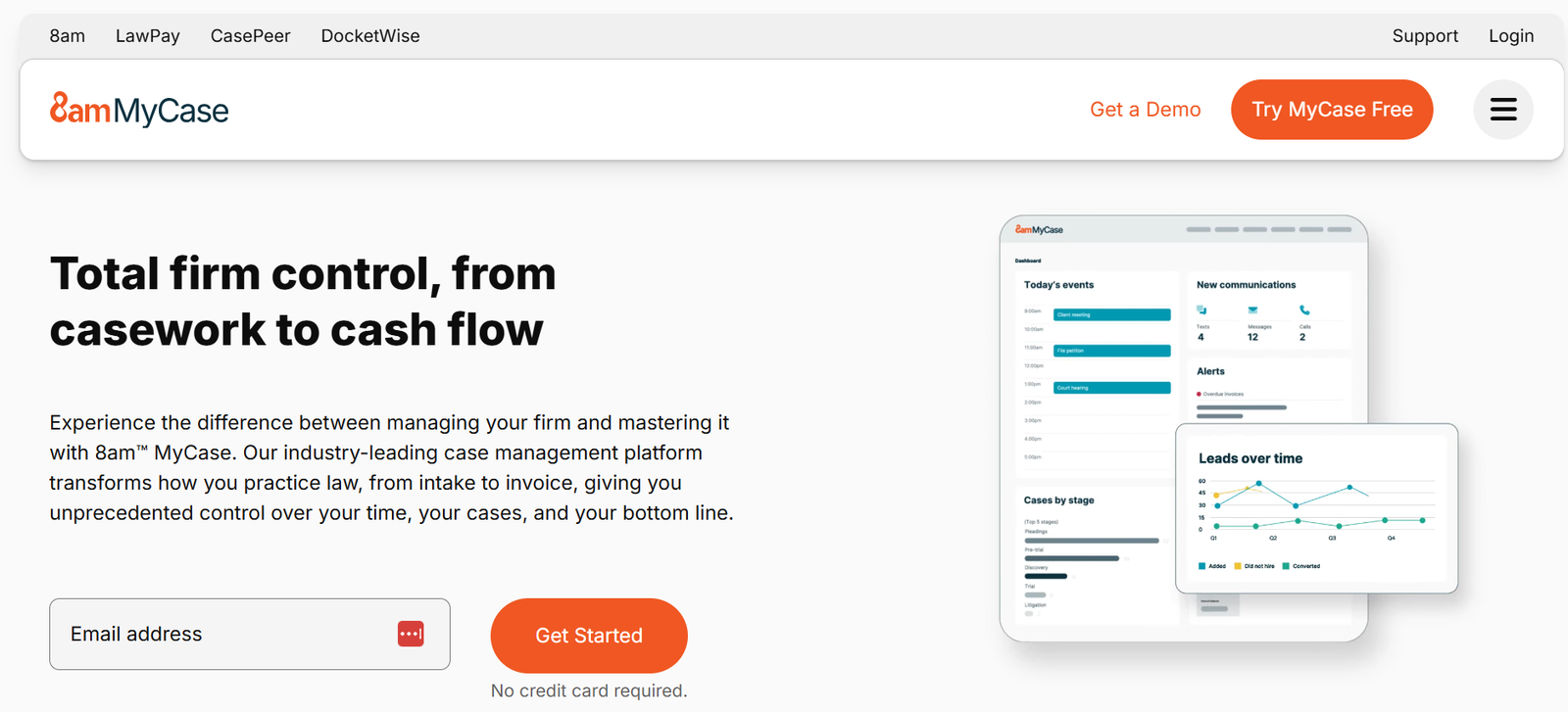
MyCase offers an all-inclusive flat-rate plan that bundles billing, client communication, and basic financial reporting without per-feature add-ons. That predictable flat rate is the core appeal for small firms tired of watching software costs creep upward with each new capability. The tradeoff is depth: firms with complex multi-practice billing structures or heavy research workflows will find the reporting and document tooling thinner than platforms built around those use cases.
4. Smokeball - Best for Automatic Time Capture Tied to Budget Tracking

Smokeball's standout feature is automatic time tracking: it captures billable time whenever a lawyer's fingers are on the keyboard and assigns it to the correct matter, directly feeding law firm budget tracking with more accurate data. Firms that consistently under-capture billable hours will see measurable revenue recovery. It's best for litigation and transactional practices with high document volume. The limitation is its deeper commitment to a local-sync architecture, which may not suit fully remote teams.
5. Microsoft Excel / Google Sheets - Best Starting Point for Firms Not Yet Ready for Software

Spreadsheets remain the default law firm budget tracking tool for solo attorneys and newly launched firms with minimal overhead and few active matters. They require zero subscription cost and allow fully custom budget templates. For firms tracking fewer than 20 active matters, a well-structured spreadsheet can be entirely adequate. The critical limitation is scalability: manual data entry creates error risk, version-control problems, and zero real-time visibility as matter volume grows.
How Legal AI Closes the Gap Between Budget Data and Billable Work Output
Legal AI and the Work-Product Gap
Practice management software records what your firm spends, but it cannot tell you what that spending actually produced. That visibility gap is where budget data stops being useful.

The Work-Product Gap in Law Firm Budget Data
Practice management software does exactly what it promises: it records time entries, logs expenses, and totals them by matter. The problem is what it cannot do. A six-hour research entry and a two-hour research entry look identical in a budget report, even if one produced a winning brief and the other produced a dead end.
Standard time-tracking tools record those hours at the matter level but cannot connect that data to the quality or speed of the actual work product produced. The result is cost data permanently disconnected from output. You know what was spent. You never know what it produced.
LeanLaw identifies the "billable hour gap" as a structural revenue leakage problem that practice management software tracks but does not resolve, because it measures time entry rather than work output. A firm could be logging every hour correctly and still have no idea whether its research workflows are generating usable deliverables or expensive dead ends. That is a visibility failure.
Most firms handle this by reviewing invoices at month-end and writing off the hours that feel unjustifiable. The hidden cost is that every written-off entry looked identical to a productive one inside the budget report, making it impossible to identify which workflows or tools generated value. Legal AI platforms built for legal workflows close this gap by embedding research and drafting directly into matter-level work, so time spent becomes traceable to a concrete, citation-grounded deliverable rather than an undifferentiated line item.
Platforms built with responsible AI governance, transparency, accountability, and risk management across AI-assisted workflows, reduce hallucination-driven corrections, citation errors, and the rework cycles that LeanLaw's analysis links directly to write-off volume.
Related Reading
- Best Apps for Attorneys
- Matter Management Systems
- Document Review Software For Law Firms
- Best AI For Legal Brief Writing
- Best AI Tools For Personal Injury Lawyers
- Best AI Tool For Legal Redlining
- AI Software For Identifying Issues In Case Files
- Best Patent AI Software For Lawyers
- Contract Drafting Tools
Next steps
If your revenue feels impossible to forecast because contingency timelines and slow-paying clients make every month a guessing game, the path forward starts with recognizing that unpredictable cash flow is a tracking problem, not an income problem.
Realization rate volatility by practice area, not aggregate revenue, is the true diagnostic lever for cash flow predictability. A single blended realization rate hides which case types are generating chaos, while a per-practice-area breakdown lets you make intake decisions that stabilize receipts before the shortfall reaches your bank account. Accounts receivable aging is a more actionable signal than any monthly P&L, because deterioration in the 60 to 90 day buckets predicts cash gaps weeks before they hit the operating account. Together, they point to one concrete next step: build a weekly review cadence that watches both numbers simultaneously, so variances get named when they are still small.
If you want to go deeper on how AI-assisted legal research connects to the billable hour gap and the work-product visibility problem that practice management software cannot solve, legal AI is worth exploring for that specific layer of law firm financial performance. Start with your last twelve months of collections, split every expense into fixed and variable categories, and set a thirty-minute recurring block on the same day each week. That calendar commitment is what converts the metrics covered here into a live budget rather than a document that stops getting updated in February.
Frequently Asked Questions
How do I handle unpredictable revenue when billing models like contingency make income almost impossible to forecast?
The post recommends anchoring projections to your utilization rate and tracking realization rate broken down by practice area rather than as a single firm-wide number. Because contingency matters can run twelve to eighteen months before any cash arrives, separating performance by case type reveals which practice areas are manufacturing cash flow chaos, enabling intake decisions that stabilize monthly receipts before a shortfall appears in the bank account.
What's the difference between fixed and variable expenses, and why does it matter for a law firm budget?
Fixed costs, rent, insurance premiums, and base salaries, are obligations you owe regardless of caseload, while variable costs, court filing fees, expert witness fees, and deposition transcripts, scale with matter volume and should be tracked separately as client disbursements. The distinction matters because the two categories respond to completely different interventions: you cannot reduce rent by taking fewer cases, but you can reduce deposition costs by settling earlier, and that lever is only visible when the two buckets are split.
How should I budget for client expenses that get reimbursed, like filing fees and expert costs?
The post is explicit that matter-level disbursements, filing fees, expert witness fees, deposition transcripts, must be excluded from your firm overhead calculation and tracked separately. Lumping them into overhead artificially inflates that figure and can mask a pricing problem in flat-fee matters, since disbursements may be consuming a significant share of matter revenue without ever appearing as a distinct line item.
How do I build a cash flow forecast when my collections are always lagging behind my billings?
The post recommends using accounts receivable aging buckets, 30, 60, and 90 days, as your earliest warning signal, because deterioration in the aging schedule predicts collection shortfalls weeks before they reach your operating account. Running a monthly actuals-versus-budget comparison in a fixed sequence (revenue collected first, then operating expenses, then matter costs) ensures that a drop in your realization rate is identified before it silently inflates the weight the expense side of the budget is carrying.
What budgeting challenges are unique to small law firms compared to other small businesses?
The post identifies three structural failures specific to law firms: billing cycles (especially contingency matters) make revenue projection feel like guesswork so firms stop projecting altogether; non-billable administrative time is never counted as a cost even though it directly reduces utilization rate and appears on payroll; and firms must manage two distinct financial layers, operational overhead and matter-level expenses, which, when conflated, cause overhead to be chronically underestimated. The result, according to the post, is that 82% of failed small businesses cite poor cash flow management.