

Billable Meaning: 10 Tasks Lawyers Can Bill Clients For
Billable meaning explained: OpenCase breaks down 10 tasks lawyers can actually charge clients for. Stop leaving revenue on the table.

Many legal professionals end the workday unsure whether they captured every hour that counts. Knowing which tasks qualify as billable work, how to record time accurately, and how to write entries that clients accept without dispute are core skills in law practice management, yet they rarely get the focused attention they deserve.
Getting this right reduces write-offs, strengthens client trust, and keeps revenue from slipping through the cracks. For firms that want to move faster and miss fewer billable moments, legal AI from OpenCase handles the heavy lifting, organizing time records and drafting precise entries that reflect the full value of the work done.
Table of Contents
- What Does Billable Mean in the Legal Profession?
- Why Is Understanding Billable Work Important for Lawyers?
- What Factors Determine Whether a Task Is Billable?
- 10 Tasks Lawyers Can Bill Clients For
- Best Practices for Recording Billable Time
- Try our Legal AI to Support your Legal Work from Research to Final Draft
Summary
- Law firms lose up to 40% of billable time due to poor time tracking, according to LawPay research, meaning nearly half of legitimate earned revenue disappears before an invoice is generated. This is not a marginal rounding problem. It is a structural gap that compounds across every attorney, every matter, and every billing cycle.
- Lawyers spend only 2.5 to 2.9 hours per day on billable work out of a typical 8-hour workday, according to data from Thomson Reuters and LawPay. That figure reframes the core problem: the goal is not to manufacture more billable hours, but to protect the legitimate ones that already exist through accurate recording and precise descriptions.
- Billing habits that go unexamined can become professional liabilities. Disciplinary cases consistently show that billing problems rarely begin with intent. They begin with patterns that accumulate over time, overlapping entries, undocumented charges, and vague descriptions that a client, judge, or bar investigator can dismantle line by line.
- Five factors determine whether a task belongs on an invoice: whether it requires legal skill or judgment, whether the time was reasonably necessary, whether the engagement agreement covers it, whether the work is non-duplicative, and whether the entry can survive outside scrutiny. A task that clears four of these filters can still fail the fifth. Courts, as established in Missouri v. Jenkins, assess the nature of the task itself, not the credentials of the person performing it.
- Block billing consistently results in fee reductions. The State Bar of California's Arbitration Advisory found that block billing warrants reductions of 10% to 30% in arbitration fees, with arbitrators retaining discretion to cut further. Separating each distinct task into its own entry is the only format that allows a client or court to verify that billed hours match the work described.
- Law firm billing rates increased by approximately 8% in 2025, according to Legal Bill Review, which means each unrecorded or disputed hour now represents more lost revenue than in prior years. Higher rates raise the stakes for every gap in time-entry discipline, since the dollar value of what slips through grows with the rate itself.
- OpenCase legal AI addresses a specific friction point in this process by grounding research and drafting in verified primary sources from Cornell LII, CourtListener, and govinfo, making the time billed for legal research traceable and defensible rather than subject to reconstruction after a client questions the entry.
What Does Billable Mean in the Legal Profession?
Billable time is the money that law firms use in their business. Every hour spent working on a client's case — writing motions, looking up past court decisions, talking about terms — is work the client agreed to pay for in the engagement letter. Without that agreement, the time spent has no bill to send to the client.
"Every hour spent on a client's case — from writing motions to researching precedents — only becomes revenue when it's backed by a signed agreement."
🎯 Key Point: Billable time is not just time worked — it's time that has been explicitly authorized by the client through a formal engagement letter. No agreement means no invoice.
⚠️ Warning: Time spent on a client's matter without a signed engagement letter in place is non-billable by default — meaning your firm absorbs that cost with zero recovery.
- Billable Time: Defined as work performed on a client matter explicitly covered by an engagement letter; is fully invoiceable.
- Non-Billable Time: Encompasses internal administration, training, or projects lacking a formal client agreement; cannot be invoiced.
- Pro Bono Time: Represents volunteer services provided without the expectation of financial compensation; is not billable.

Where does the billable meaning get lost in the billing cycle?
The failure point is usually not laziness or incompetence, but the gap between work performed and work recorded. According to the LawPay Blog, law firms lose up to 40% of billable time due to poor time tracking. Nearly half of legitimate, earned revenue vanishes before an invoice is generated. This structural leak compounds across all attorneys, matters, and billing cycles.
Why does memory failure erode the billable meaning of completed work?
Most attorneys rebuild their day from memory at the end of the week, pulling pieces from calendar entries and email threads. Memory degrades fast, and a task completed Tuesday morning feels uncertain by Friday. OpenCase's legal AI grounds research and drafting in verified primary sources from Cornell LII, CourtListener, and govinfo, making the work more defensible and the time spent on it carry clearer professional weight on an invoice.
What makes a time entry actually hold up
A billable entry is more than a number: it is a description that connects a task to a client matter and includes sufficient detail for the client to accept it without question. Vague entries like "research" or "calls" invite disputes and write-downs, converting billable time into non-billable time after the fact. Precise entries tied to specific tasks separate firms that collect what they earn from those that constantly discount their work.
What does billable time look like when hours are already limited?
LawPay's 2025 research found that lawyers spend only 2.9 hours per day on billable work out of an 8-hour workday. The goal is to protect billable time by recording it accurately, describing it clearly, and submitting it with sufficient detail so that clients pay without issues.
Related Reading
- Law Practice Management
- Google Gemini For Lawyers
- Claude vs. ChatGPT for Lawyers
- ChatGPT Prompts For Lawyers
- Copilot For Lawyers
- Ai Use Cases For Lawyers
- Ai Legal Hallucinations
- Legal Tech Trends
- Prompt Engineering For Lawyers
- Legal Writing Ai
- Claude For Lawyers
- Ai Legal Ethics
Why Is Understanding Billable Work Important for Lawyers?
Treating billable work as a core professional discipline directly protects your revenue, your license, and your reputation. Every hour spent on a client matter only counts when you record it accurately, describe it in sufficient detail so it can withstand review, and submit it promptly to reflect the actual work you performed. When that chain breaks, the problems add up fast — and the consequences can be far more serious than a missed invoice.
💡 Tip: Think of billable work discipline as a three-part chain: record it, describe it, and submit it. Break any link in that chain and your revenue, credibility, or compliance could be at risk.
"Every hour spent on a client matter only counts when you record it accurately, describe it in detail so it can withstand review, and submit it to show the actual work you did." — Core Principle of Billable Work Management
⚠️ Warning: Failing to maintain accurate billing records isn't just a financial problem — it can put your professional license and client relationships at serious risk.
- Record accurately – Prevents lost billable time.
- Describe clearly – Reduces billing disputes.
- Submit promptly – Supports accurate billing and cash flow.
🔑 Takeaway: Billable work is not just an administrative task — it is a core professional discipline that safeguards your practice from the ground up.

What does the billable meaning gap cost attorneys every week?
The State Bar of California's 2020 Annual Discipline Report shows the Office of Chief Trial Counsel opened nearly 17,500 cases of attorney misconduct, filed formal disciplinary charges against 180 attorneys, and recommended discipline, including 79 disbarments and 114 suspensions. Billing and fee-related complaints rank among the most common grounds for these investigations.
This gap shows how much legitimate, billable work disappears between the moment it happens and when it gets recorded. Client calls taken between meetings, quick research questions answered on the fly, and document reviews squeezed into the last 20 minutes before lunch are real services rendered that vanish without disciplined recording habits. The attorney who captures billable time immediately recovers hours that their peers silently forfeit every week.
How can billing errors end a career built over decades?
A March 2026 Iowa Supreme Court decision illustrates the consequences. The court suspended attorney Valerie Cramer's law license for two years after finding she billed clients twice, charged for work never performed, and submitted fee applications a probate judge called "extremely troubling". One case involved a fee application requesting more than $35,000 from a single estate, with the court finding excessive time claimed, duplicated billing entries, and charges for tasks never performed. The Grievance Commission found the billing scheme was neither sophisticated nor hidden: ordinary scrutiny of the invoices exposed it. A license built over two decades collapsed over invoices that a client, judge, or opposing counsel could read and immediately question.
How do billing habits become a liability over time?
Billing problems rarely start on purpose. They build up through overlooked habits. The Mathahs and Cramer cases both show how overlapping entries and undocumented charges create records that clients, judges, and bar investigators can scrutinize line by line. The invoice is the one piece of your work product that every non-lawyer in the room feels qualified to challenge.
What does billable mean when documenting research sources?
Most lawyers pull research sources from wherever they can find them, trusting that citations will hold up. The hidden cost emerges when a client or opposing counsel traces a cited authority to an unverifiable source, or when a billing entry's research log lacks sufficient detail to justify claimed hours. OpenCase grounds research and drafting in verified primary law from Cornell LII, CourtListener, and govinfo, making research time traceable to authoritative sources rather than approximations that invite dispute.
Why this shapes a career, not just a paycheck
Lawyers who treat billing as important from the start keep good records: no disputed invoices that escalate to malpractice claims, no bar complaints from clients who feel overcharged, and no year-end write-offs that signal problems to firm leadership. Understanding billing protects the hours you already work by ensuring they're documented and defensible under scrutiny.
The harder question most lawyers never ask is which tasks qualify for billing in the first place.
What Factors Determine Whether a Task Is Billable?
Five factors determine whether a task belongs on an invoice: whether it requires legal skill or judgment, whether the time spent was reasonably necessary, whether the client's engagement agreement covers it, whether the work is non-duplicative, and whether the entry can survive outside scrutiny. Each filter works independently, and a task that passes four can still fail the fifth.
"A task that passes four out of five billing filters can still fail — every criterion must be satisfied independently before a charge belongs on an invoice."
Every billable entry should pass these checks:
- Professional expertise – Did the task require legal skill or judgment?
- Reasonable time – Was the time proportionate to the work?
- Contract coverage – Is the charge authorized by the engagement agreement?
- No duplication – Is the task billed only once?
- Defensible – Would a neutral reviewer consider the charge reasonable?
🎯 Key Point: All five factors function as independent filters — passing the majority is not enough. A single failed criterion is sufficient to remove a task from a billable invoice.
⚠️ Warning: The most commonly overlooked filter is outside scrutiny. Even tasks that feel justified internally can fail if they wouldn't hold up under court review or client audit — always apply this test before submitting.

The nature of the task, not the title of the person doing it
The failure point is often misidentified. Most attorneys assume their professional status elevates whatever they touch. Courts don't share that assumption. As the Supreme Court made clear in Missouri v. Jenkins, purely clerical work—filing, scheduling, organizing documents—remains non-billable regardless of who performs it, because the task's nature sets its billing value, not the attorney's credentials. An attorney performing administrative work due to a lack of support staff still performs non-billable work. The task defines the rate.
When accuracy and reasonableness pull in opposite directions
Attorneys often confuse accurate time recording with billable time recording. Accuracy answers what happened. Reasonableness answers whether a paying client should fund it. According to the LawPay Blog, lawyers spend only 2.5 hours per day on billable work out of an 8-hour workday. An attorney who spends three hours researching a settled point of law records that time accurately, yet Hensley v. Eckerhart holds it shouldn't reach an invoice if a competent attorney would have recognized the answer in thirty minutes.
What does billable meaning look like when verification goes wrong?
Most lawyers research by searching databases, pulling cases, and manually verifying that the law still applies. This process incurs costs when it requires legal analysis, with hidden expenses emerging when verification fails: a cited case turns out to be overruled or a statute changes, forcing the lawyer to either miss the error or spend extra time tracking it down. OpenCase solves this directly by basing its research on verified primary sources from Cornell LII, CourtListener, and govinfo, so a lawyer's analysis can be traced to authoritative legal sources from the start.
The engagement agreement sets the outer boundary
Whether something can be billed depends on the specific terms the client agreed to. Outside counsel guidelines at large corporations routinely exclude travel time billed at full rate, cap associate hours on routine tasks, and require prior approval before a second attorney touches a matter. A task can require genuine legal skill and still fall outside what a specific client contracted to pay for. The engagement letter is one of the most practical billing tools an attorney has, not a formality to file away after signing.
How does duplication undermine billable meaning in fee reviews?
LawPay's research shows that law firms lose up to 40% of possible revenue due to non-billable time and poor tracking. Duplication creates additional problems: hours that were tracked, billed, and then removed. Two attorneys researching the same question, a partner rewriting work a senior associate completed, three lawyers on a call where one would suffice—each entry is correct, yet none passes a reasonableness review without cuts.
The Alabama FLSA case demonstrated how repeated staffing issues compound the problem. A court cut an entire fee request in half because the staffing pattern could not be justified, regardless of how carefully each individual hour was logged.
Once you understand which tasks qualify, the next question proves more specific than most attorneys expect.
Related Reading
- Law Firm Seo
- Is ChatGPT Good For Personal Injury Lawyers
- Iolta Account
- Will Lawyers Be Replaced By Ai
- How To Use ChatGPT for Legal Research
- Legal Billing Software
- Lawyer Salary
- Objections In Court
- Law Firm Marketing
- Legal Ai Tools
- Law Clerk
10 Tasks Lawyers Can Bill Clients For
Not every hour an attorney logs earns a place on the invoice, but core legal work does — provided it reflects real legal skill and stays within the client's fee agreement. Below are ten tasks attorneys can bill clients for, backed by the ethics rules and case law that define what belongs on a legitimate invoice.
"A legitimate legal invoice reflects real legal skill — grounded in ethics rules and case law that define exactly what billable work looks like." — Legal Billing Best Practices
💡 Tip: Always cross-reference every billed task against your jurisdiction's ethics rules before sending an invoice — even experienced attorneys can inadvertently include non-billable time.
⚠️ Warning: Billing for tasks that fall outside the client's fee agreement — no matter how much time was spent — can expose attorneys to disciplinary action, fee disputes, and malpractice claims.
Every billable task should meet these requirements:
- Core legal work – Reflects genuine legal skill.
- Client agreement – Falls within the agreed scope.
- Ethics compliance – Meets jurisdictional standards.
- Case law support – Withstands judicial scrutiny.

1. Legal Research
Legal research is billable work because it requires the analytical training that a law degree provides. ABA Model Rule 1.5(a) cites "the time and labour required" and "the novelty and difficulty of the questions involved" as justifications for fees; legal research exemplifies both. However, attorneys must carefully track overlap: an hour spent researching an issue applicable to two clients cannot be billed in full to each client, as that would double-bill for a single hour of work.
2. Drafting and Reviewing Legal Documents
Contracts, pleadings, motions, briefs, and settlement agreements are the main deliverables that consume billable time. The Supreme Court's reasoning in Missouri v. Jenkins, 491 U.S. 274 (1989), explains the distinction: substantive drafting work requires legal judgment and warrants professional billing rates, whereas clerical tasks such as formatting or filing do not. An attorney reviewing opposing counsel's draft, redlining language, and advising a client on the legal consequences of specific clauses performs the work this category protects.
3. Client Consultations and Case Strategy Discussions
Meetings and calls in which a lawyer advises a client on legal options, case strategy, or risks are billable because they involve the professional judgment for which clients are paying. This covers initial intake conversations through mid-litigation strategy sessions about settlement versus trial. The North Carolina State Bar's 2022 Formal Ethics Opinion 4 confirms that lawyers may bill for substantive client-facing work so long as the billing structure is honest and consistent with what the client agreed to at the outset of representation (ncbar.gov).
4. Court Appearances and Hearings
Time spent appearing before a judge—whether for a motion hearing, status conference, or trial—is a straightforward billable category that requires direct client representation. However, attorneys must avoid stacking: appearing in court for four different clients during the same calendar call requires dividing courthouse time fairly across all matters handled, rather than billing each client for the full block. Ethics guidance confirms that overlapping time must be split rather than billed in full to every client involved.
5. Depositions and Discovery Work
Getting ready for and attending depositions, drafting interrogatories, reviewing document productions, and handling e-discovery count as billable legal work because each task requires legal judgment about which evidence matters and how to use it. The Supreme Court's footnote in Missouri v. Jenkins specifically lists "help with depositions, interrogatories, and document production" as tasks that require professional billing rates when performed by an attorney or a properly supervised paralegal. Discovery work generates some of the highest hour volumes in litigation, making accurate, specific time entries essential: unclear or block-billed discovery entries are frequently targeted for reduction in fee disputes and fee-shifting cases.
6. Negotiations and Settlement Discussions
Negotiating on a client's behalf—whether working out settlement terms, reviewing a contract's business points, or discussing plea terms in a criminal matter—is billable because it requires legal judgment about value, risk, and leverage that a client cannot exercise alone. This includes direct negotiation sessions and strategic preparation, such as evaluating a settlement offer against the likely outcome of continued litigation. ABA Model Rule 1.5(a)'s reasonableness factors, including the results obtained and the skill required to perform the service properly, apply directly to negotiation work, since a well-negotiated outcome often provides the clearest measure of the value a client received for the attorney's time.
7. Trial Preparation
Getting witnesses ready, organizing exhibits, writing jury instructions, and developing trial strategy are billable tasks that require careful legal analysis. Trial-prep hours often concentrate in the weeks before trial, so maintaining detailed records is essential. Courts applying the "billing judgment" standard from Hensley v. Eckerhart, 461 U.S. 424 (1983) expect fee petitions to show how trial-prep hours were allocated across tasks, rather than grouped into unclear, multi-day entries. Task-specific entries protect this category from the substantial cuts courts impose when trial-prep billing appears inflated or repetitive.
8. Legal Correspondence and Substantive Client Communications
Writing demand letters, responding to opposing counsel, and writing substantive updates that advise a client on case developments are billable because they require legal judgment about tone, strategy, and what information the recipient needs to hear. The Supreme Court's list in Missouri v. Jenkins specifically includes "drafting correspondence" among tasks commanding professional billing rates. A letter analyzing a legal position is billable; a short email confirming a meeting time is administrative and non-billable.
9. Substantive Paralegal-Assisted Work Performed Under Attorney Supervision
Factual investigation, witness interviews, compiling financial or statistical data, and fact-checking are billable when performed by a properly supervised paralegal. Missouri v. Jenkins establishes that paralegal work tied to substantive legal tasks is compensable at market rates because the use of paralegals lowers overall litigation costs. The substance of the task, not the job title of the person performing it, determines billability: purely clerical or secretarial work remains non-billable regardless of who performs it.
10. Travel Time for a Client Matter
Time spent traveling to a deposition, hearing, or client meeting may be billed, subject to the fee agreement. North Carolina's 2022 Formal Ethics Opinion 4 permits attorneys to bill an agreed rate—full or reduced—for travel time connected to a specific client case, provided the client consents in advance.
What does billable time look like when attorneys travel for multiple clients?
Attorneys cannot double-dip: state ethics opinions, including Alaska Formal Opinion 96-4, hold that a lawyer who spends three hours flying to one client's deposition and uses that flight to draft a motion for another client may not bill both clients for the full travel time.
Best Practices for Recording Billable Time
Recording billable time well is a skill that determines whether an invoice passes client review, whether a fee petition holds up in court, and whether the firm collects the revenue it actually earned.
"The way time is recorded determines whether a firm collects the revenue it actually earned — making accurate time entry one of the highest-value habits in legal practice." — Legal Billing Best Practices
💡 Tip: Treat every time entry as a mini-document — it must be clear, defensible, and detailed enough to survive client scrutiny or judicial review.
⚠️ Warning: Poor time recording habits don't just cost billable revenue — they can undermine fee petitions, trigger billing disputes, and damage client trust beyond repair.
Accurate billing protects key outcomes:
- Client invoice review – Avoids write-offs and disputes from vague entries.
- Fee approval – Supports court review with detailed time records.
- Revenue collection – Ensures recorded work gets paid.
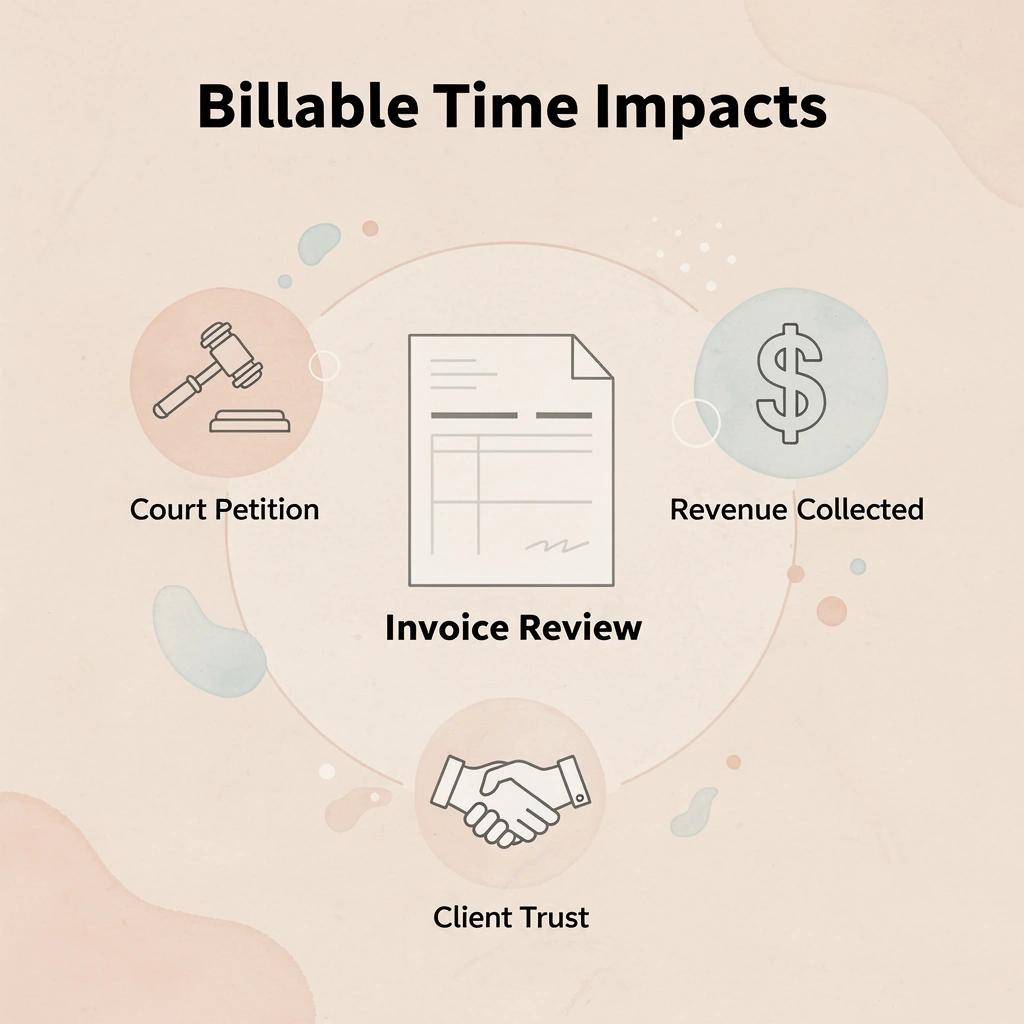
🎯 Key Point: Billable time recording is not just an administrative task — it is a core professional skill that directly impacts firm profitability, client relationships, and the legal enforceability of fees.
The case for same-day entries
Entering time immediately is the single habit that protects every other billing practice on this list. Memory deteriorates within hours, not days, meaning an attorney rebuilding a timesheet at week's end is guessing at duration rather than reporting what actually happened. The California State Bar's guidance on ethical billing notes that entries made after the fact carry less credibility than contemporaneous records in the event of a fee dispute.
Why does block billing cost you more than time?
A single entry reading "research, draft motion, call with client, review discovery, 6.0 hours" tells a reviewer nothing about how much time went to any individual task, and that ambiguity invites a reduction. The State Bar of California's Arbitration Advisory found that block billing warrants reductions of 10% to 30% in arbitration fees, with arbitrators retaining discretion to cut further. Breaking a day's work into separate entries for each distinct task allows a client or court to verify that the hours billed match the work described.
How does the billable meaning get lost between research and drafting?
Most attorneys research and write by switching between a research platform and their document, then record time from memory. This workflow creates an accuracy problem: it becomes nearly impossible to separate how much time went to finding authorities versus writing the argument itself. Legal AI platforms like OpenCase work directly inside Microsoft Word, displaying verified case law, statutes, and citations as an attorney writes. Because every authority OpenCase shows is traced to primary sources from Cornell LII, CourtListener, and govinfo, attorneys spend less time re-confirming findings, and time entries reflect genuine legal analysis rather than duplicated verification work.
Descriptions that answer the question before it's asked
How you write a time entry matters as much as how long it takes. "Legal research" doesn't tell a client much; "researched statute of limitations defences applicable to breach of contract claim" tells them exactly what they paid for and why it mattered to their case. Vague descriptions are what courts and fee auditors notice first—a description that could apply to any matter gives no way to judge whether the time was reasonably spent. Write each entry as though the client will read it and ask a follow-up question.
One review step that catches what same-day logging misses
Reviewing bills before sending them catches errors that real-time tracking cannot. Even careful entries can include tasks that took longer than the work justified. Attorneys should read through a matter's time entries before invoicing, looking for entries that seem long relative to the task, duplicate work by another timekeeper, or time spent correcting their own drafting errors (generally not recoverable in disputes). This review step catches problems internally before a client's accounts-payable department or a court does.
What does "billable" mean in relation to closing the revenue gap?
Most billing problems are not ethical failures but system failures: gaps between when work is performed and when it is recorded, between what an attorney meant to write and what appears on the invoice. Closing that gap separates a firm that collects what it earns from one that perpetually wonders where the revenue went.
Once you close that gap, the quality of the work itself improves unexpectedly.
Related Reading
- Everlaw
- Spellbook
- Clio
- Law Insider
- Ivo
- Harvey
- Legora
- Best Ai Contract Review Tool
- ChatGPT For Lawyers
Try our Legal AI to Support your Legal Work from Research to Final Draft
When you close the gap between work performed and work recorded, administrative drag shrinks and recovered time flows back into substantive legal work—the kind that carries real weight with clients and holds up under scrutiny.
"When administrative drag shrinks, recovered time flows directly back into the substantive legal work that carries real weight with clients and holds up under scrutiny."
🔑 Takeaway: Every minute not lost to administrative overhead is a minute reinvested into high-value, client-facing legal work that strengthens your practice.
⚡ Did You Know? Legal professionals who integrate AI-powered tools directly into their existing workflows report dramatically faster turnaround on research-backed deliverables—without sacrificing citation accuracy or source verification.
OpenCase brings AI-powered research directly into Microsoft Word and Outlook, surfacing verified case law, extracting citations, and linking arguments to primary sources from Cornell LII, CourtListener, and govinfo—without interrupting your drafting workflow. The result is billable work that is faster to complete and easier to stand behind—research-backed, citation-verified, and ready for client delivery, all from within the tools you already use every day.
✅ Best Practice: Use OpenCase to keep your research, citation extraction, and drafting workflow unified inside a single environment—eliminating the costly context-switching that slows down final draft delivery.