

Prompt Engineering for Lawyers: 11 Best Practices for 2026
Prompt engineering for lawyers, simplified. OpenCase breaks down 11 proven practices to get better AI results in less time.

Vague AI responses are a common frustration for lawyers, and the problem usually starts with the prompt. When a question lacks context or precision, even a capable AI tool will return something generic and unhelpful. Prompt engineering gives lawyers a practical way to fix that by learning how to communicate clearly with AI, so the output is accurate, relevant, and actually usable in legal work.
Strong prompts matter most when the stakes are high, whether drafting documents, researching case law, or managing client matters within a broader Law Practice Management workflow. The techniques covered here apply across AI tools, but they deliver the best results when paired with a platform built for legal work, like legal AI.
Summary
- Prompt quality, not model capability, is the primary driver of AI output quality in legal work. A 2025 study published in Scientific Reports found that a structured prompt engineering framework raised expert-rated legal quality scores by 18 to 20 points on a 100-point scale, with measurable gains in citation accuracy and reasoning soundness. The improvement came entirely from better instructions, not a more advanced model.
- Vague prompts create compounding errors that are difficult to catch because the output looks authoritative even when it is wrong. When a prompt omits the governing jurisdiction, procedural posture, or applicable standard of review, the AI fills those gaps with statistically probable content rather than legally accurate content. A fabricated case citation arrives formatted exactly like a real one, and a multi-jurisdiction summary reads like controlling authority, which makes weak prompting especially dangerous in legal contexts.
- Structured inputs produce measurably more reliable outputs across legal tasks. Research using the Contract Understanding Atticus Dataset found that well-structured prompts, combined with clear formatting signals and repositioned task instructions, pushed GPT-4.1's exact-match accuracy to 79 percent, a gain of roughly 30 percentage points over poorly structured prompts. That gap represents the difference between a memo that holds up under partner review and one that ships with the wrong controlling authority embedded in it.
- Confidentiality risks in AI prompting are architectural, not incidental. When lawyers paste unredacted settlement figures, client names alongside litigation strategy, or privileged internal memos into general-purpose tools, that information leaves the firm's control the moment the prompt is submitted. Abstracting or excluding confidential details from prompts is itself a prompt engineering skill that most lawyers have not been formally trained to apply.
- Reusable prompt templates are firm assets, not individual habits. A prompt that worked well on a specific legal question contains institutional knowledge, and storing, versioning, and sharing it across a team converts one lawyer's careful thinking into a durable resource. Most legal AI use remains ad hoc, with attorneys rebuilding effective prompts from scratch because no system exists to capture what works, making safeguards dependent on individual diligence rather than a systematic process.
- The profession has already decided that AI literacy is a baseline competency. According to Bloomberg Law's 2026 Path to Practice Survey of more than 1,800 lawyers, students, and faculty, three-quarters of practicing attorneys expect new hires to arrive knowing how to cite-check AI-generated materials. That expectation reflects how quickly prompt construction and output verification have moved from optional skills to professional requirements.
- OpenCase legal AI addresses the verification problem at the structural level by grounding every output in primary sources from Cornell LII, CourtListener, PACER/RECAP dockets, and govinfo's Federal Register and CFR, so well-constructed prompts return traceable authority rather than statistically plausible text.
What Is Prompt Engineering, and Why Is It Important for Legal Work?
Prompt engineering is the practice of building AI instructions that are clear enough that the output needs judgment, not rebuilding. For lawyers, this difference matters enormously: badly built prompts create work that seems authoritative but isn't — and fixing it costs more than starting over.
"Badly built prompts create work that seems authoritative but isn't — and fixing it costs more than starting over."
Prompt Quality
- Well-engineered prompt
- What Happens: Output needs judgment and light review
- Cost to Fix: Low
- Poorly built prompt
- What Happens: Output appears correct but requires rebuilding
- Cost to Fix: High — often more than starting over
💡 Definition: Prompt engineering is not just typing a question into an AI — it's the deliberate craft of structuring instructions so the AI produces output that is legally sound, precise, and usable from the start.
⚠️ Warning: A prompt that produces confident-sounding but inaccurate legal output is worse than no output at all — it creates hidden rework and professional risk that can compound quickly.

Why precision matters more in law than almost anywhere else
The failure point is almost always specificity. When a prompt omits the controlling jurisdiction, applicable standard of review, or required analytical framework, the AI fills those gaps with statistically probable rather than legally accurate content: fabricated citations, misapplied rules, and conclusions that sound correct until tested by a partner or opposing counsel. According to the Thomson Reuters Law Blog, five core prompt engineering techniques directly address these failure modes in legal work, each targeting the gap between what lawyers ask and what AI needs to produce reliable output.
What does a well-structured prompt actually look like for legal work?
The most effective prompts give the model a clear role, provide the facts, explain the applicable rules, and specify the required answer format. This structure is the difference between a draft that requires complete rewriting and one that needs careful review. A well-engineered legal prompt constrains how the model interprets information, focuses the analysis, and enables verification against known facts.
Why does prompt engineering for lawyers require more context than most teams provide?
Most legal teams handle AI prompting like a quick email to a junior associate: a sentence or two with minimal context and an assumption that the recipient understands. This fails when the model lacks prior knowledge of the matter, client, or jurisdiction. OpenCase is built around this dynamic. Because every output is grounded in verified primary sources from Cornell LII, CourtListener, PACER/RECAP dockets, and govinfo's Federal Register and CFR, a well-constructed prompt unlocks traceable, citation-verified answers that lawyers can independently check rather than blindly trust.
Prompt engineering as a professional skill, not a technical one
A 2025 study published in Scientific Reports tested a structured prompt-engineering framework across 500 legal AI samples and found that it raised expert-rated legal quality scores by 18 to 20 points on a 100-point scale, with measurable gains in citation accuracy and reasoning soundness. This improvement stemmed from better instructions, not a better model. Prompt engineering is the professional skill of communicating clearly with a tool that takes you literally—a practice lawyers already employ when drafting interrogatories, writing jury instructions, or defining contract terms.
Why does prompt engineering for lawyers create lasting firm value?
Once tested prompts exist for repetitive tasks, they become firm assets. Every case receives the same accuracy, and every team member starts from the same professional baseline rather than improvising. That consistency drives the real efficiency gain.
What Challenges Do Lawyers Face When Writing AI Prompts?
The failure point is usually invisible until it costs a lot of money. A lawyer submits a prompt, receives output that looks authoritative, and moves forward. Generative models are trained to produce confident, well-structured prose, which means a fabricated case citation arrives formatted exactly like a real one. That surface credibility is what makes weak prompting so dangerous in legal work specifically.
"Generative models are trained to produce confident, well-structured prose — which means a fabricated case citation arrives formatted exactly like a real one."
⚠️ Warning: The most dangerous AI output in legal work isn't obviously wrong — it's convincingly formatted. A hallucinated case citation looks identical to a real one, making manual verification non-negotiable.
💡 Tip: Before submitting any AI-generated legal content, always cross-reference case citations against authoritative legal databases. Surface credibility is not the same as factual accuracy — and in law, that distinction can be career-defining.
Challenge
- Fabricated case citations Why It's Dangerous Risk Level
- Formatted identically to real citations
- 🔴 Critical
Challenge
- Confident-sounding errors Why It's Dangerous Risk Level
- AI prose appears authoritative by design
- 🔴 Critical
Challenge
- Weak prompt construction Why It's Dangerous Risk Level
- Vague prompts invite hallucinated outputs
- 🟠 High
Challenge
- Invisible failure points Why It's Dangerous Risk Level
- Errors only surface after submission
- 🟠 High

Where vague instructions create compounding errors
General prompts lead the model to guess based on patterns in regular text, not from your client's file, state laws, or the case at hand. Ask a model to "summarize the enforceability issues with this non-compete" without specifying which state's laws apply, the employee's job, or the applicable legal standard, and you'll get an answer that sounds like a law school test question: it covers basic rules well but misses the specific details that decide the case. Fixing that answer takes longer than writing the analysis yourself, and an incomplete draft risks reaching your client.
Why does prompt engineering for lawyers matter in contract and regulatory work?
The same pattern shows up in contract drafting and regulatory research. A prompt that omits the specific agency, applicable CFR section, or relevant comment period produces plausible output that applies the wrong rule. According to the IBA Legal Agenda 2025, the International Bar Association ranks AI as a critical issue, reflecting how these risks have shifted from theoretical to practice-level concerns. Lawyers treating prompt construction as an afterthought are not saving time; they are deferring a verification problem to the worst possible moment.
What happens when lawyers rely on AI to explore unfamiliar territory?
Most teams review AI output against their own knowledge, catching errors after the fact rather than preventing them through better input. This works when the lawyer already knows the answer well enough to spot deviations, but fails when using AI to explore unfamiliar territory—precisely when the tool is most valuable. OpenCase addresses this gap by grounding every output in verified primary sources from Cornell LII, CourtListener, PACER/RECAP dockets, and govinfo's Federal Register and CFR, so verification doesn't rest entirely on the lawyer's memory of an unfamiliar jurisdiction.
Why confidentiality risks live inside the prompt itself
The confidentiality exposure in AI prompting isn't theoretical. When a lawyer pastes an unredacted settlement figure, a client's name, or a privileged memo into a general-purpose tool, that information leaves the firm's control immediately. Consumer-grade AI tools weren't designed with Model Rule 1.6 in mind, and "anonymizing" a fact pattern doesn't reliably eliminate re-identification risk when the underlying facts are unique.
How does prompt engineering for lawyers reduce confidentiality exposure?
Prompts need to be written so that secret information is hidden or left out completely, a skill most lawyers have not been trained to do. Business-level platforms with SOC 2 Type II and ISO/IEC 27001 compliance that clearly do not use client information to train their models operate differently from the tools most lawyers currently use.
What does a failed prompt actually cost a legal practice?
Damien Charlotin's AI Hallucination Cases Database has found 1,798 legal decisions worldwide where courts dealt with AI-generated hallucinated content in filings. The quieter cost is the loss of confidence in a tool that, when used correctly, speeds up legal work. Every failed prompt, every iteration cycle, every discovery after submission of fabricated authority erodes the efficiency case for legal AI adoption. Prompt engineering discipline isn't an extra burden—it's what makes the work trustworthy.
The hardest part isn't learning to write a better prompt. It's knowing what "better" looks like.
Related Reading
- Law Practice Management
- Google Gemini For Lawyers
- Claude vs. ChatGPT for Lawyers
- ChatGPT Prompts For Lawyers
- Copilot For Lawyers
- Ai Use Cases For Lawyers
- Ai Legal Hallucinations
- Legal Tech Trends
- Legal Writing Ai
- Claude For Lawyers
- Ai Legal Ethics
What Makes a Good Legal AI Prompt?
A good legal AI prompt is not a polished paragraph of plain English — it is a structured set of constraints that narrows the model's probability space down to professionally defensible outputs.
"A good legal AI prompt is a structured set of constraints that narrows the model's probability space down to professionally defensible outputs, not a polished paragraph of plain English."
🎯 Key Point: The goal of a legal AI prompt is precision over polish — vague inputs produce vague, legally unreliable outputs.
💡 Tip: Always treat your prompt as a set of guardrails, not a casual question. The more structured constraints you apply, the more defensible and actionable the AI's response becomes.
Weak Prompt
- "Tell me about contracts"
Strong Legal AI Prompt
- Specific clause type, jurisdiction, and party context defined
Weak Prompt
- "Is this legal?"
Strong Legal AI Prompt
- Jurisdiction, applicable statute, and fact pattern included
Weak Prompt
- "Summarize this case"
Strong Legal AI Prompt
- Output format, relevant legal standard, and use case specified

Role assignment is the first constraint, not an optional nicety
Define the model's role with precision before anything else. "Senior litigation associate specializing in employment claims under California law" produces fundamentally different output than "legal assistant." The role instruction shapes vocabulary, analytical depth, and risk orientation in ways that no amount of additional description can replicate. Without it, the model defaults to a neutral encyclopedic tone that treats every jurisdiction and practice area as interchangeable.
How does naming jurisdiction and hard limits reduce wrong-law drift?
After role assignment, the prompt must explicitly name the controlling jurisdiction, procedural posture, and material facts, then state what the model cannot invent or omit. Research using the Contract Understanding Atticus Dataset found that well-structured inputs, system prompt task instructions, and Markdown formatting signaling pushed GPT-4.1's exact-match accuracy to 79 percent—a gain of roughly 30 percentage points over poorly structured prompts. That gap is the difference between a memo that withstands partner review and one that ships with the wrong controlling authority embedded.
How does prompt engineering for lawyers gain from verified primary sources?
Most legal teams rely on individual lawyers to exercise judgment about what information to include. This fails quietly when lawyers are inexperienced or rushed. OpenCase solves this structurally: every output draws from verified primary sources including Cornell LII, CourtListener, PACER/RECAP dockets, and govinfo's Federal Register and CFR, providing traceable authority rather than statistically probable text. This distinction matters in enterprise contexts where SOC 2 Type II and ISO 42001 compliance set minimum standards for the production and storage of AI-generated legal work.
Output format and verification instructions are not finishing touches
Telling the AI exactly what format you want—whether an IRAC memorandum, a clause-by-clause risk table, or a numbered list of sources with pin cites—transforms open-ended writing into a controlled process that mirrors legal analysis. According to Thomson Reuters, structured prompting requires consistent effort. When you combine format requirements with clear instructions to flag uncertainty and list sources, you embed verification into the generation process. Three-quarters of practicing attorneys expect new hires to know how to check AI-generated materials for accuracy, according to Bloomberg Law's 2026 Path to Practice Survey of more than 1,800 lawyers, students, and faculty, showing that the profession now treats this as a fundamental skill.
Prompts are firm assets, not disposable inputs
A prompt that worked well on a California non-compete question contains institutional knowledge. Storing it, versioning it against real outputs, and sharing it across the team converts one lawyer's careful thinking into a durable firm resource. Most legal AI use remains ad hoc, with each attorney rebuilding effective prompts from scratch because no system exists to capture what worked. Reusable prompt templates embedded in matter workflows make safeguards systematic rather than dependent on individual diligence.
What happens when prompt engineering for lawyers meets a platform built to respond?
Once you understand what a well-built prompt can do, the next question becomes: what happens when the platform itself is designed to meet that prompt halfway?
Related Reading
- Law Firm Marketing
- Legal Ai Tools
- Will Lawyers Be Replaced By Ai
- Iolta Account
- Law Clerk
- Lawyer Salary
- Legal Billing Software
- Law Firm Seo
- Is ChatGPT Good For Personal Injury Lawyers
- How To Use ChatGPT For Legal Research
- Objections In Court
- Billable Meaning
7 Practice-Area Specific Prompt Examples
The best legal AI prompts are made for specific areas of law. Commercial contract review, criminal defense research, and estate planning have fundamentally different goals, rules, documents, and risks. By customizing prompts to the legal issue, jurisdiction, audience, and desired output, lawyers can generate responses that are more accurate, more relevant, and far easier to verify.
"By customizing prompts to the legal issue, jurisdiction, audience, and desired output, lawyers can generate responses that are more accurate, more relevant, and easier to verify." — Core Principle of Practice-Area AI Prompting
🎯 Key Point: A generic prompt produces generic results — practice-area specificity is the single biggest lever for improving AI output quality in legal work.
🔑 Takeaway: Three major practice areas — commercial contracts, criminal defense, and estate planning — each demand entirely different prompt structures, because the stakes, terminology, and verification requirements are never the same.
Commercial Contract Review
- Primary Goal: Identify liability & gaps
- Key Risk: Missed obligations
- Output Type: Redline summary
Criminal Defense Research
- Primary Goal: Find precedent & defenses
- Key Risk: Jurisdictional error
- Output Type: Case law memo
Estate Planning
- Primary Goal: Structure asset transfer
- Key Risk: Compliance failure
- Output Type: Draft documents

1. Contract Drafting and Review
Contracts reward precision because every defined term and carve-out carries commercial consequences. A prompt that simply asks for an agreement lets the model invent market-standard language that may not fit the parties' relative leverage or governing law. The stronger version assigns a clear role, names the transaction type and jurisdiction, lists exact required provisions, and specifies formal drafting conventions so output arrives ready for attorney review rather than wholesale rewriting.
Weaker version: Draft an NDA.
Stronger version: You are a corporate attorney representing a Delaware corporation in a possible acquisition. Draft a mutual non-disclosure agreement that includes: (1) a definition of confidential information covering financial projections, customer lists, and technical data with standard exclusions for publicly available information; (2) a two-year confidentiality obligation with indefinite survival for trade secrets; (3) a one-year standstill provision; (4) an eighteen-month non-solicitation of employees restriction; and (5) Delaware law and exclusive Chancery Court jurisdiction. Use defined terms, formal numbering, and plain-English drafting suitable for immediate mark-up.
2. Litigation and Motion Practice
Motion work turns on procedural posture, the exact legal standard, and the limited facts before the court. A well-designed prompt keeps the model focused on the correct procedural vehicle, states the governing standard, supplies key facts, dictates the required organizational structure, and forbids fabricated citations so the draft remains ethically usable.
Weaker version: Write a motion to dismiss.
Stronger version: You are defense counsel in the Southern District of New York. Prepare a memorandum of law supporting a motion to dismiss under Federal Rule of Civil Procedure 12(b)(6). The complaint alleges that our client, a corporate director, breached their duty to the company by rejecting a single merger proposal. Argue that the business-judgment rule applies and that the pleading fails to allege specific facts overcoming the presumption of good faith. Organize the memorandum with sections for Introduction, Statement of Facts, Legal Standard, Argument with sub-headings, and Conclusion. Rely only on established legal principles without inventing or naming specific case citations.
3. Legal Research and Analysis
Research prompts fail when they omit jurisdiction, comparison set, or anti-hallucination constraints. The model then returns a free-form essay mixing outdated rules with invented authorities. A disciplined research prompt identifies exact statutes or doctrines, requires structured comparison, sets a confidence threshold, and flags uncertainty for lawyer verification.
Weaker version: What are the rules about data privacy?
Stronger version: You are a privacy counsel focused on state legislation in the United States. Prepare a side-by-side comparison of data-breach notification duties under the California Consumer Privacy Act (as amended by CPRA), the Virginia Consumer Data Protection Act, and the Colorado Privacy Act. For each statute, address: (a) the triggering event for notification, (b) the statutory timeline, (c) the parties who must receive notice, and (d) the statutory penalties. Present the comparison in a table. Reference only provisions you assess as accurate and explicitly flag any provision that may have changed after 2025.
4. Regulatory Compliance
Compliance work requires careful attention to detail and focus on the biggest risks, as enforcement consequences are real and often serious. A vague prompt creates a basic checklist that misses the client's actual data flows and vendor relationships. The better version describes how the client operates, lists missing controls, and asks the model to connect each gap to the specific regulatory rule and possible penalty range.
Weaker version: Is our company GDPR compliant?
Stronger version: You are a data-protection attorney advising a United States e-commerce company that sells to European Union customers and processes names, email addresses, purchase histories, and payment data. The company maintains a privacy policy but lacks a designated Data Protection Officer, records of processing activities, and data-processing agreements with vendors. Produce a prioritized gap-analysis checklist divided into immediate risk-mitigation steps, actions required within ninety days, and ongoing compliance measures. For each item, cite the relevant GDPR article and potential administrative fine range.
5. Employment Law Counseling
Employment matters depend on definitions specific to each law, protected groups, and documentation standards that vary by state. Generic prompts risk mixing federal and state rules or misapplying safe-harbor language. A prompt tailored to a specific practice keeps the model focused on controlling law, client size or industry, and deliverables, ensuring guidance remains useful and correct for the jurisdiction.
Weaker version: Advise on how to fire an employee.
Stronger version: You are employment counsel advising a California employer with more than fifty employees. The client intends to terminate a non-exempt sales employee for documented performance deficiencies after progressive discipline. Outline the steps required to minimize risk under the California Fair Employment and Housing Act and the California Labor Code, including final-pay timing, personnel-file access rights, and required notices. Flag documentation that should exist in the file and list three questions the client must answer before proceeding.
6. Intellectual Property Review
IP analysis requires understanding how claims are constructed, being aware of prior art, and maintaining clear ownership chains. Broad requests produce shallow summaries that miss important details in prosecution history or assignment gaps. Better prompts assign a specialized role, identify the asset type, and request structured output (such as a risk matrix) to support negotiation or clearance decisions.
Weaker version: Review this patent.
Stronger version: You are an intellectual-property attorney conducting a freedom-to-operate assessment for a software client. Review the attached claim set from a U.S. utility patent in machine-learning recommendation systems. Identify claim elements that appear broad relative to the specification, note dependent claims that may narrow scope, and list potential design-around options. Present findings in a three-column table: Claim Element, Risk Observation, Suggested Follow-Up Question for Prosecution Counsel. Do not invent prior art.
7. Client Communications
Clients need clear, accurate explanations without complicated language. A prompt that simply says "rewrite this" will preserve legal terms. A better version identifies the audience, sets a word limit, requests everyday comparisons, and specifies decision points. This transforms the email into a decision-making tool rather than another difficult memo.
Weaker version: Rewrite this for the client.
Stronger version: You are a corporate attorney writing to a non-lawyer chief executive. Rewrite the attached analysis of an indemnification clause as a client email of fewer than three hundred words. Explain the principal risks in everyday language, use one short analogy to illustrate the financial exposure, avoid undefined legal terms, and close with three specific questions the executive must answer before approving the clause.
Research into practice-management platforms continues to examine how firms can store, version, and audit these practice-area templates so that the same disciplined structure is available for every matter rather than relying on individual memory.
11 Best Practices for Prompt Engineering for Lawyers
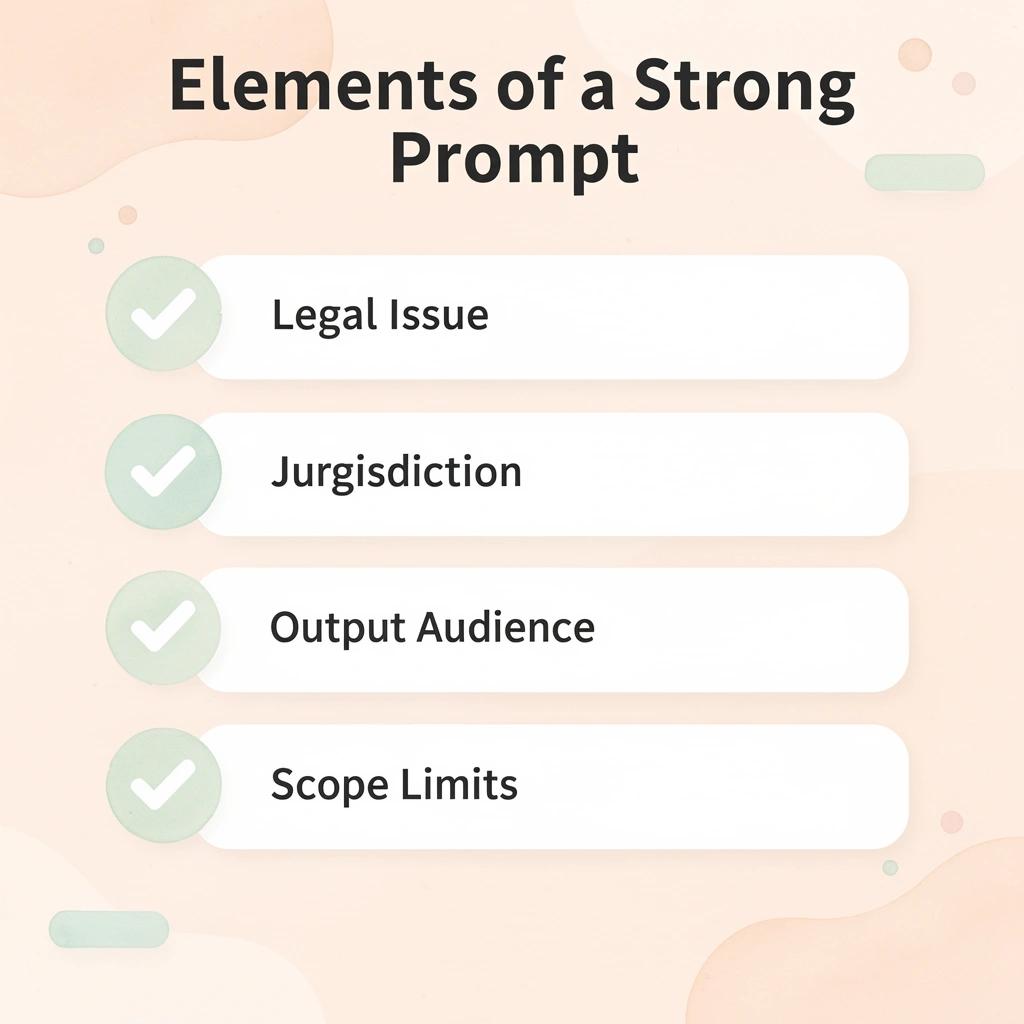
Well-written prompts decide whether AI creates meaningful legal work or basic text that needs a lot of fixing. Good prompts explain the legal issue, jurisdiction, audience, output format, and limits — every single element matters. Following prompt engineering best practices makes drafting better, makes research faster, reduces hallucinations, and keeps professional standards while keeping human judgment central to every legal task.
"Well-written prompts decide whether AI creates meaningful legal work — or basic text that needs a lot of fixing." — Prompt Engineering for Lawyers
🎯 Key Point: A strong prompt is not just a question — it's a structured legal brief for your AI, covering jurisdiction, audience, and output format before a single word is generated.
🔑 Takeaway: The difference between a good AI output and a great one comes down to prompt quality. Lawyers who master prompt engineering best practices spend less time fixing AI-generated text and more time on high-value legal judgment — the work only humans can do.
Prompt Element: Legal Issue
- Why It Matters: Focuses the AI on the specific area of law
Prompt Element: Jurisdiction
- Why It Matters: Ensures legally accurate, region-specific output
Prompt Element: Audience
- Why It Matters: Tailors tone for client, court, or colleague
Prompt Element: Output Format
- Why It Matters: Delivers briefs, memos, or summaries as needed
Prompt Element: Limits
- Why It Matters: Reduces hallucinations and keeps scope controlled
1. Assign a Precise Professional Role
Tell the model exactly who it should act as: a senior employment lawyer in California, a business litigator preparing a Rule 12(b)(6) motion, or a transactional attorney reviewing for a private-equity buyer. Role assignment shapes vocabulary, depth of analysis, risk orientation, and assumptions the model makes. Without it, the response defaults to a neutral, encyclopedia-style summary that ignores practical demands.
2. Specify Jurisdiction and Governing Law Up Front
In your opening sentences, name the controlling jurisdiction, the applicable statute or rule set, and the relevant procedural posture. Legal outcomes depend on these details. Omitting them allows the model to conflate rules from multiple jurisdictions or apply outdated standards. Stating the jurisdiction explicitly keeps the analysis within the correct legal framework from the start.
3. Supply Complete and Relevant Factual Context
Include important facts, key documents, disputed clauses, and your client's objectives. Generative models lack independent knowledge of your case file. Precise factual information prevents the model from filling gaps with statistically common but factually incorrect details. Context transforms generic requests into matter-specific instructions.
4. Use Clear, Unambiguous Language
Use simple, direct sentences. Avoid unclear technical terms, double negatives, and vague verbs like "examine" or "assist." Explain specialized words when you first use them. Clear writing gives the model less room to guess your meaning, so you'll get better results that need less revision.
5. Define the Required Output Structure and Format
Say exactly what you need: an IRAC memo with specific headings, a risk table analyzing each clause, a comparison chart, or a client email within a word limit. Specifying the format helps the model organize information as lawyers use it and makes the result easier to verify, revise, and integrate into existing work.
6. Require Step-by-Step Reasoning
Tell the model to work through the analysis one step at a time or to "think step by step" before reaching a conclusion. This chain-of-thought guidance improves consistency when dealing with multi-part legal tests, reveals intermediate reasoning for verification, and effectively handles complex standards with multiple elements.
7. Embed Anti-Hallucination and Source Requirements
Tell the model to cite only sources from the materials you provided or from well-known primary sources. It should flag uncertainty and avoid fabricating case names or quotes. Combine these instructions with human review of every citation.
8. Break Complex Assignments into Sequential Steps
For multi-part tasks like full contract reviews, multi-issue research memos, or compliance gap analyses, divide the work into ordered stages and request one stage at a time or a numbered plan first. Sequential prompting prevents the model from collapsing distinct issues into a single superficial answer and allows you to correct course between steps.
9. Provide Concrete Examples When Format or Style Matters
When the output needs to follow a strict template, tone, or analytical approach, include one or two short examples of what you want. Examples guide the model more reliably than general descriptions and reduce variability across multiple uses.
10. Iterate and Refine Based on Actual Results
Think of the first prompt as a rough draft. Look at what you get back, identify any missing pieces or incorrect guesses, and try again with clearer rules or more detail. The best results come from successive refinement rather than from attempting a single perfect instruction.
11. Protect Confidentiality and Select Purpose-Built Tools
Never put private client information or personally identifiable details into general-purpose consumer models. Choose platforms made for legal professionals that encrypt data, exclude inputs from model training, and base responses on verified primary sources. OpenCase is built specifically for legal teams with these protections.
What makes a legal AI platform safe for prompt engineering for lawyers?
OpenCase is a legal AI platform for research, drafting, and citations trained on Cornell LII's authoritative datasets of U.S. statutes and Supreme Court opinions. It indexes federal and state opinions, RECAP dockets, and authenticated government publications, allowing answers to be traced to primary law records. The platform maintains enterprise-grade privacy with data encrypted in transit and at rest, never used to train its models.
How OpenCase Improves Prompt Engineering for Lawyers
A well-written prompt sent into the wrong environment still gives you the wrong kind of answer. The gap between a precise legal question and a trustworthy legal answer depends heavily on what the platform does with that question once it gets it.
"A well-written prompt sent into the wrong environment still gives you the wrong kind of answer — the platform itself is half the equation." — OpenCase
🎯 Key Point: Prompt quality alone is not enough. Even the most carefully crafted legal query will fail if the underlying platform isn't built to handle legal-specific context and accuracy requirements.
💡 Tip: When evaluating AI tools for legal work, don't just ask "can I write better prompts?" — ask "is this platform designed to receive and process legal prompts correctly?" The environment matters as much as the input.
Factor
- Generic AI Platform
- Legal context awareness: Limited
- Prompt interpretation: General
- Answer trustworthiness: Variable
- Gap between question & answer: Wide
- OpenCase
- Legal context awareness: Purpose-built
- Prompt interpretation: Legal-specific
- Answer trustworthiness: Optimized for accuracy
- Gap between question & answer: Significantly reduced

Why do general-purpose AI tools create problems for prompt engineering for lawyers?
The most common frustration legal professionals report is not that AI fails dramatically, but that it fails quietly. A fabricated citation arrives formatted like a real one. A summary covering multiple jurisdictions reads as controlling authority. General-purpose tools require lawyers to fact-check everything afterward, turning a time-saving tool into a liability audit. That is a platform problem, not a prompting problem.
How does OpenCase make prompt engineering for lawyers more reliable?
OpenCase addresses this problem structurally. Our Project Prompt feature lets lawyers select jurisdiction before any query runs, forcing the model to operate within a single legal framework rather than blending rules from multiple states or circuits.
Every answer traces back to verified primary sources: Cornell LII's statutory and Supreme Court datasets, authenticated govinfo PDFs covering the Federal Register and CFR, and daily-indexed federal and state opinions from CourtListener and RECAP dockets. When a prompt asks for case support, our platform returns traceable authority, not statistically plausible text. According to a landmark study reported by Forbes, AI tools can improve legal work quality by up to 28%, but that gain only materializes when underlying sources are trustworthy.
What changes when the drafting environment is connected?
The failure point in most AI-assisted legal workflows is the gap between research and the working document. Lawyers generate a response in one window, copy it, paste it into Word, reformat it, and repeat for each iteration. OpenCase closes that gap by running directly inside Microsoft Word and Google Docs, producing usable draft language in the document already open on screen. Iteration happens in context, keeping the lawyer's judgment engaged with the actual work rather than logistics.
How does matter context make prompt engineering for lawyers more precise?
The context of a case makes this more accurate. OpenCase works with Clio and connects directly to files in Google Drive and Dropbox, so prompts work with actual case documents rather than manual summaries reconstructed from memory. For litigation work, daily PACER docket ingestion means procedural queries show the current case status, not information from a training cutoff months ago. The prompt doesn't need to carry the entire factual record because the platform already has it.
What security and governance standards protect confidential client data?
OpenCase maintains SOC 2 Type II compliance, ISO/IEC 27001 certification, and ISO 42001-aligned AI governance. Client data is encrypted in transit and at rest and is never used to train AI models. For lawyers who need to attach matter documents and draft detailed prompts without exposing confidential information, this architecture is essential. The platform is built for trained legal professionals who apply independent judgment, with controls ranging from jurisdiction selection to the Sources Portal, which lets lawyers verify where each answer originated.
The real question is whether the outputs you are getting now could hold up in court.
Related Reading
- Clio
- Legora
- Best Ai Contract Review Tool
- Harvey
- Everlaw
- ChatGPT for Lawyers
- Ivo
- Spellbook
- Law Insider
Try our Legal AI to Support your Legal Work from Research to Final Draft
Prompt engineering only works at its best when you have the right setup. Writing clear, location-specific prompts in a basic AI tool still means you have to check citations yourself, move between different research websites, and hope your sources are correct. This back-and-forth work adds up quickly and takes away the time you were trying to save.
"Writing clear prompts in a basic AI tool still means you have to check citations yourself, move between different research websites, and hope your sources are correct." — The hidden cost of fragmented legal AI workflows
⚠️ Warning: Even the most carefully crafted prompts can't fix a fragmented workflow — if your AI tool doesn't verify sources, every output carries legal risk you'll have to catch manually.
Workflow Type
- Basic AI Tool
- Citation Checking: Manual — you verify
- Research Integration: Separate websites
- Time Cost: High
- OpenCase in Word
- Citation Checking: Built-in & verified
- Research Integration: All-in-one platform
- Time Cost: Minimal
🔑 Takeaway: A well-written prompt is only as strong as the platform behind it — without verified citations and integrated research, you're still doing the hardest work yourself.
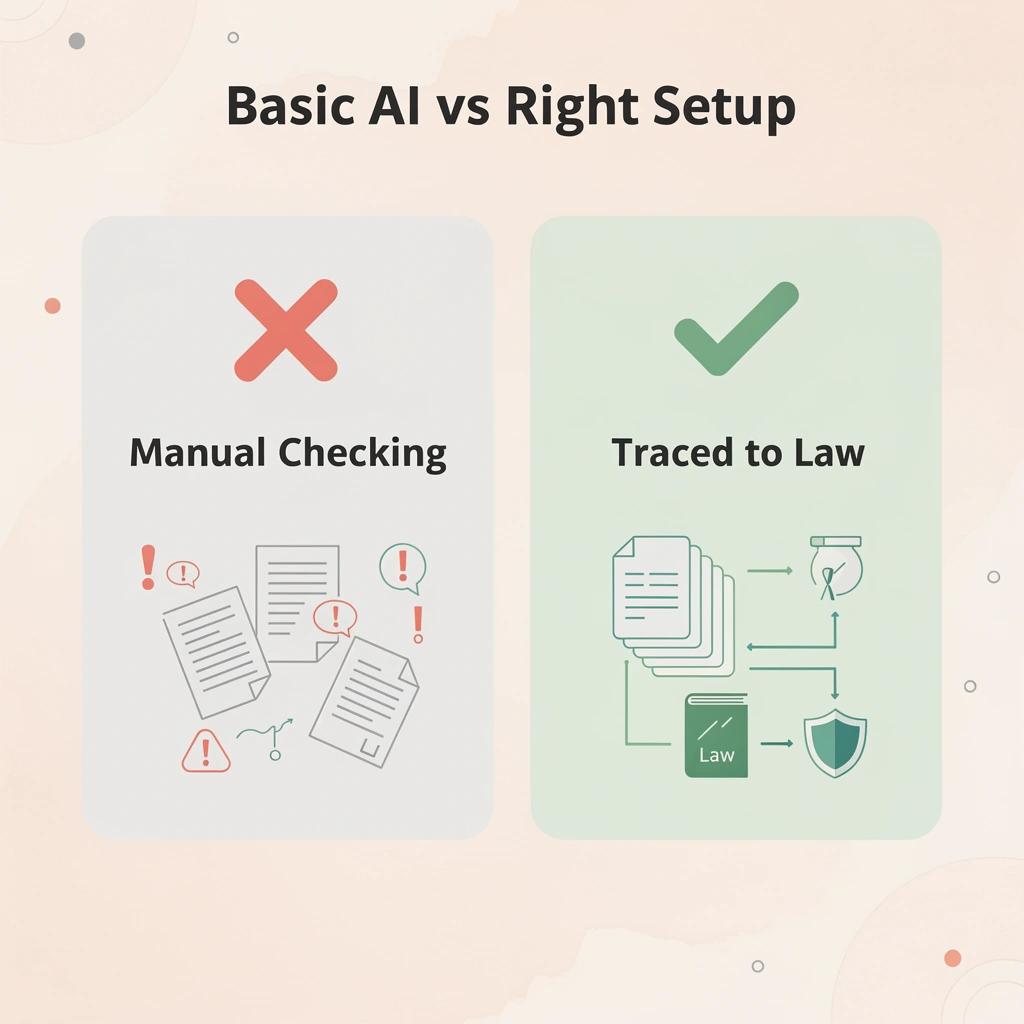
OpenCase puts legal research, drafting, and checked citations in one place inside Microsoft Word. The care you put into every prompt creates work you can trace back to the actual law, not an AI's best guess. Start using OpenCase today to transform better prompts into stronger work that's ready for court.
💡 Tip: Because OpenCase lives inside Microsoft Word, there's no platform-switching. Every prompt you write instantly connects to verified legal sources and a court-ready draft in the same window.
✅ Best Practice: Pair your location-specific, well-structured prompts with OpenCase's built-in citation verification to ensure every argument you draft is fully traceable to real, reliable law.