

Is ChatGPT Good for Personal Injury Lawyers? 7 Best Use Cases
Is ChatGPT good for personal injury lawyers? OpenCase breaks down 7 real use cases that save time and win more clients.

Personal injury attorneys spend a significant portion of their day on repetitive tasks: drafting demand letters, summarizing medical records, and fielding routine client questions. As AI tools like ChatGPT become more accessible, many firms are weighing whether these tools can meaningfully reduce that workload without sacrificing quality. The honest answer is that ChatGPT offers real value in some areas and clear limitations in others.
General-purpose AI works well for broad drafting and research tasks, but personal injury law involves nuances such as medical lien tracking, case timelines, and client communication that a generic tool is not built to handle. Law practice management becomes more effective when the technology fits the workflow rather than the other way around. For firms that want AI purpose-built for personal injury work, legal AI from OpenCase is designed to support the way these cases actually move.
Table of Contents
- What Is ChatGPT, and Which Legal Tasks Can ChatGPT Help With?
- Is ChatGPT Good For Personal Injury Lawyers
- Can ChatGPT Be Trusted for Legal Research?
- 7 Best Use Cases for Using ChatGPT in a Personal Injury Practice
- How to Use ChatGPT in a Personal Injury Practice Without Ethical Risks
- How OpenCase Complements ChatGPT in a Legal Workflow
- Try our Legal AI to Support your Legal Work from Research to Final Draft
Summary
- Personal injury attorneys face a documentation burden that compounds across dozens of active files simultaneously. Medical records, treatment histories, liability narratives, and settlement correspondence all require structured, professional writing at high volume. ChatGPT addresses this by generating first drafts, organizing case timelines, and producing plain-language client communications at a pace that meaningfully reduces time spent on routine tasks.
- Adoption of AI tools in law firms has accelerated sharply, with the American Bar Association's 2024 Legal Technology Survey finding that AI use among law firms nearly tripled from 11% in 2023 to 30% in 2024. That pace means many attorneys are integrating these tools before fully understanding where reliability ends. The efficiency gains are real, but they depend on structuring the workflow correctly from the start.
- The hallucination problem in AI-generated legal research is not a minor inconvenience. ChatGPT has cited fabricated cases in at least one high-profile legal filing, resulting in sanctions against the attorneys involved. The outputs follow legal sentence structure, include plausible docket numbers, and read as authoritative, which is precisely what makes unverified citations more likely to slip through without challenge.
- Client perception of AI-generated legal content adds another layer of complexity. Research published by The Conversation found that participants rated ChatGPT-generated legal advice as more trustworthy than lawyer-generated advice in 7 out of 10 legal scenarios. That finding suggests that the clarity and confidence of AI output can actually reduce the instinct to verify it, thereby increasing rather than reducing risk when the underlying sources are not confirmed.
- Law firms using AI-assisted workflows report saving six or more hours per week per attorney, according to Bolt Data Legal's report on AI-assisted legal workflows. Those savings only hold when drafting tools and verification tools are treated as separate functions. Hours recovered through faster drafting disappear when attorneys spend equal time correcting fabricated citations or responding to sanctions motions.
- The gap between AI adoption speed and AI reliability is where most workflow problems originate. Only 8.2% of consumers used ChatGPT to research attorneys in 2025, compared with over 70% who used Google, suggesting clients are not yet evaluating firms based on their internal AI use. That creates a window for firms to build reliable AI workflows before external scrutiny increases.
- This is where legal AI fits in: OpenCase legal AI addresses the verification gap by searching across 100-plus legal databases grounded in Cornell LII statutes, Supreme Court opinions, and authenticated government records, so citations are built into the research output rather than requiring a separate manual review pass after the fact.
What Is ChatGPT, and Which Legal Tasks Can ChatGPT Help With?
ChatGPT is a general-purpose AI assistant built on large language models trained to process and generate human language. According to Coursera, GPT-4 passed the bar exam in the top 10% of test takers — a remarkable benchmark for any AI system. However, capability and reliability in legal practice are two very different things.
"GPT-4 passed the bar exam in the top 10% of test takers." — Coursera
💡 What ChatGPT Is: At its core, ChatGPT is a conversational AI tool — it can draft, summarize, research, and explain legal concepts, but it is not a licensed attorney and should never replace qualified legal counsel.
- Drafting contracts: ✅ Yes — Excellent for templates, but requires attorney review to ensure specific legal protections.
- Legal research summaries: ✅ Yes — Effective for overview, but verify all citations independently to avoid hallucinations.
- Court filings: ⚠️ Limited — High-risk; rigorous attorney oversight is essential to prevent errors.
- Explaining legal concepts: ✅ Yes — Strong, clear general explanations for foundational topics.
- Case strategy: ❌ No — Entirely dependent on human legal judgment and case-specific context.
⚠️ Critical Warning: ChatGPT can hallucinate case citations and legal statutes. Always verify AI-generated legal content with a qualified professional before use.

What tasks does ChatGPT actually handle well for personal injury lawyers?
ChatGPT excels at repetitive, low-stakes tasks involving substantial text, provided you review the work carefully. Give it a deposition transcript and ask it to create a timeline of important events. Give it a set of facts and ask it to write a first draft of a demand letter. It organizes information quickly, maintains logical order, and solves the blank-page problem that slows experienced attorneys. For personal injury lawyers handling many cases, faster drafting directly improves efficiency.
How does ChatGPT reduce the time spent on routine client communication?
The same applies to client communication. ChatGPT writes clear, plain-language status updates, intake summaries, follow-up emails, checklists, and organized case notes. It helps attorneys prepare deposition questions from scattered discovery materials. These unglamorous tasks consume hours each week, and reducing that workload directly affects how many cases a firm can advance simultaneously.
Where the tool hits a hard ceiling
The failure point is usually citation. ChatGPT does not verify its legal references against primary sources. It can produce case names, statutes, and legal principles that sound authoritative but are fabricated or outdated. Most attorneys who have tested it for research have encountered this firsthand: confident-sounding citations that do not exist. For legal research informing strategy or filings, this is a serious problem.
Why does the drafting-to-research workflow break down at scale?
Most personal injury firms use ChatGPT for drafts and administrative tasks while relying on separate tools for research. This workflow breaks down as case volume grows and the distinction between "drafting support" and "legal analysis" blurs. Legal AI built specifically for verified research closes that gap by grounding every answer in citations that are verified against primary sources.
Is ChatGPT good for personal injury lawyers when adoption outpaces fitness for purpose?
ChatGPT reached 1 million users within 5 days of launch, demonstrating rapid adoption among legal professionals. However, fast adoption does not guarantee that a tool works well for its purpose. A general-use tool requires more human oversight in specialized fields than one designed specifically for legal practice from the outset.
Understanding what ChatGPT can and cannot do reveals its implications for personal injury practice.
Is ChatGPT Good For Personal Injury Lawyers
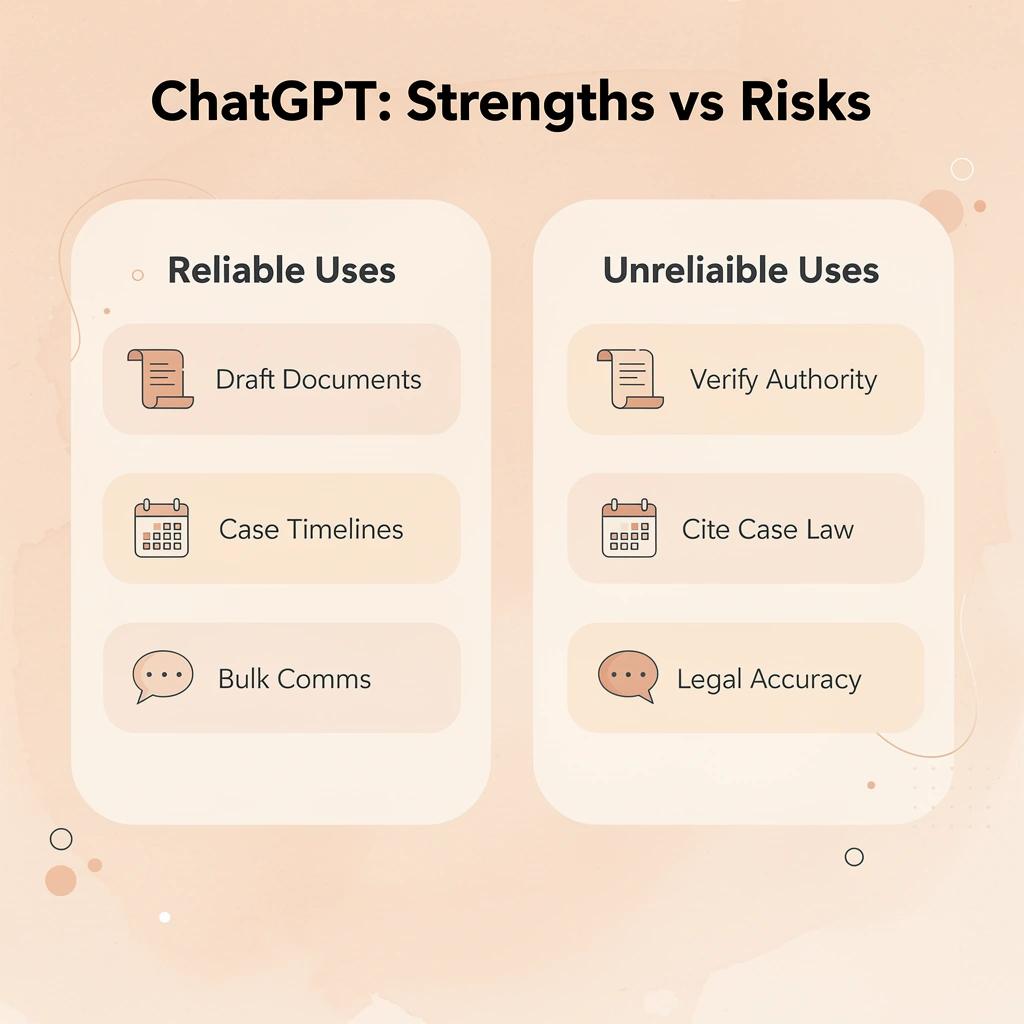
ChatGPT is useful for personal injury lawyers for specific tasks: speeding up document drafting, organizing case timelines, and handling large volumes of communication. However, it becomes critically unreliable when asked to verify legal authority or provide detailed legal analysis — and understanding exactly where that line falls is essential for any firm relying on AI tools.
"ChatGPT performs well on task-based workflows like drafting and organization, but breaks down when asked to verify legal authority or deliver accurate legal analysis." — AI Law Librarians, 2026
- High Reliability: Excellent for document drafting, timeline organization, and managing communications where structure and speed are the primary goals.
- Low Reliability: Unsuitable for legal authority verification or detailed legal analysis due to the high risk of hallucinations and lack of access to real-time, authoritative case databases.
💡 Tip: Use ChatGPT as a productivity accelerator for administrative and drafting tasks — but never as a substitute for verified legal research tools.
⚠️ Warning: Relying on ChatGPT to verify legal authority is one of the most dangerous mistakes a personal injury lawyer can make — AI hallucinations in legal contexts can have serious professional consequences.
🔑 Takeaway: The value of ChatGPT for personal injury lawyers is real but narrow — it excels at speed and organization and fails at accuracy and legal verification.
Where ChatGPT actually earns its place
Lawyers benefit most from ChatGPT when they treat it as a drafting assistant rather than a legal authority. In personal injury work, the documentation burden is relentless: medical records, treatment histories, liability narratives, and settlement correspondence pile up across dozens of active files simultaneously. ChatGPT handles that volume with speed a human cannot match when starting from a blank page. According to the iLawyerMarketing 2025 Consumer Research Study, only 8.2% of respondents used ChatGPT to research attorneys, meaning clients are not yet relying on it to evaluate legal credibility—so the reputational risk of using it internally for drafting is lower than many assume.
Why does the adoption gap matter for personal injury lawyers using ChatGPT?
In 2025, over 70% of consumers used Google to research attorneys. The gap between 70% and 8.2% reveals where AI tools stand in the legal world: helpful within law firms, but mostly invisible to clients evaluating you. ChatGPT can improve your internal work without changing how clients perceive your skills.
Is ChatGPT good for personal injury lawyers for legal research?
Most personal injury firms review ChatGPT outputs before anything leaves the office—this works for demand letters and client updates. The problem emerges when attorneys use the same tool for legal research, expecting speed and reliability. The outputs look authoritative and cite cases with docket numbers, but some citations don't exist. A confident-sounding hallucination is far more dangerous than an obvious error. Purpose-built legal AI like OpenCase grounds answers in verified primary sources, reducing the verification burden on the attorney rather than multiplying it.
Where does the line between useful and risky actually fall?
The failure point is usually misalignment of expectations, not the tool itself. When a personal injury attorney uses ChatGPT to draft a first version of a rear-end collision complaint, filling in specific facts and reviewing the output, that is a legitimate efficiency gain. When that same attorney asks it to identify the controlling precedent on comparative negligence in their jurisdiction, they are asking a general-purpose text generator to perform specialized legal research—a task in which the tool cannot reliably alert users to errors. These are fundamentally different jobs, and conflating them is where practices get into trouble.
Is ChatGPT good for personal injury lawyers when used for the right tasks?
ChatGPT earns its place in a personal injury practice when used for what it was built to do: generate structured, professional text at speed. Injury case timelines, client-facing explanations of medical terminology, and initial drafts of correspondence to insurance adjusters deliver genuine productivity gains. The attorneys who get the most value have drawn a clear internal line between tasks where speed matters most and tasks where accuracy cannot be compromised.
The deeper question of what happens when that line gets tested in legal research specifically determines whether these efficiency gains hold up under pressure.
Related Reading
- Law Practice Management
- Google Gemini For Lawyers
- Claude vs. ChatGPT for Lawyers
- ChatGPT Prompts For Lawyers
- Copilot For Lawyers
- Ai Use Cases For Lawyers
- Ai Legal Hallucinations
- Legal Tech Trends
- Prompt Engineering For Lawyers
- Legal Writing Ai
- Claude For Lawyers
- Ai Legal Ethics
Can ChatGPT Be Trusted for Legal Research?
ChatGPT produces legal research that sounds believable, which is exactly what makes it dangerous. The smooth writing is not a sign of accuracy: it predicts what a believable legal answer should sound like, rather than finding what the law actually says.
"The smooth writing is not a sign of accuracy — ChatGPT predicts what a believable legal answer should sound like rather than finding what the law actually says."
⚠️ Warning: Confident-sounding output is not the same as correct legal output. ChatGPT is optimized for plausibility, not precision: a critical distinction in any legal context.
🔑 Takeaway: The most dangerous AI errors in legal research aren't obvious. They're wrapped in polished, authoritative language that can fool even experienced practitioners.
What does a ChatGPT hallucination actually look like in a legal brief?
The failure mode is not random gibberish but a confidently cited case with a plausible name, a realistic docket number, and a holding that fits your argument perfectly—except none of it exists.
In Mata v. Avianca (S.D.N.Y. 2023), attorneys Steven Schwartz and Peter LoDuca submitted a brief citing six non-existent cases that ChatGPT had invented. The court fined them $5,000 for failing to verify the citations, damaging their professional reputations. Similar outcomes occur across jurisdictions when attorneys rely on ChatGPT as a trusted research source.
How often does ChatGPT hallucinate on legal queries?
Stanford researchers found that general-purpose models like ChatGPT hallucinate between 58% and 82% of the time when answering legal questions. Even specialized legal AI tools make mistakes 17% to 34% of the time—error rates no competent attorney can accept.
Why is ChatGPT a good source to avoid for personal injury lawyers?
In Johnson v. Dunn (N.D. Ala. 2025), lawyers from a prominent law firm faced disqualification, bar referrals, and orders to notify all current clients and judges after submitting ChatGPT-generated motions containing fabricated citations. The court stressed that such misconduct damages the court system, client interests, and the lawyers' professional standing in ways that extend far beyond monetary penalties.
The lawyers did not suspect anything because the output looked exactly like what verified research produces. That is the trap.
Why confident output is not the same as verified output
Lawyers risk error by treating ChatGPT as reliable for explaining negligence standards, duty of care, or comparative fault doctrine. ChatGPT doesn't pull from Westlaw or Lexis; it generates text based on patterns in its training data. When data on a specific jurisdiction or recent ruling is sparse, it fills gaps with plausible-sounding content that fails under judicial scrutiny.
Where does the gap between fluency and grounding create real risk for attorneys?
Most lawyers handle ChatGPT research the way they handle a junior associate's first draft: they read it, assume it seems correct, and move on. A junior associate can be asked to show where they found their information. ChatGPT cannot show a source it never actually looked at. That gap between seeming confident and having real proof is where legal penalties, bar complaints, and hurt clients happen.
Is ChatGPT good for personal injury lawyers when courts require verified citations?
Attorneys who rely on purpose-built legal AI for case law retrieval work from a fundamentally different starting point. Instead of generating text that resembles legal authority, OpenCase returns citations traceable directly to the court record, statute, or regulation they came from.
The trust gap that makes this worse
Research from The Conversation found that people rated ChatGPT-generated legal advice as more trustworthy than lawyer-generated advice in 7 out of 10 legal scenarios. This matters because ChatGPT's clarity and confidence—qualities that make it seem helpful—also make unverified output more likely to slip through unchallenged. When a tool sounds authoritative, the urge to double-check weakens.
Related Reading
- Lawyer Salary
- Iolta Account
- Legal Billing Software
- Billable Meaning
- Law Clerk
- Will Lawyers Be Replaced By Ai
- Objections In Court
- Law Firm Marketing
- How To Use ChatGPT for Legal Research
- Law Firm Seo
- Legal Ai Tools
7 Best Use Cases for Using ChatGPT in a Personal Injury Practice
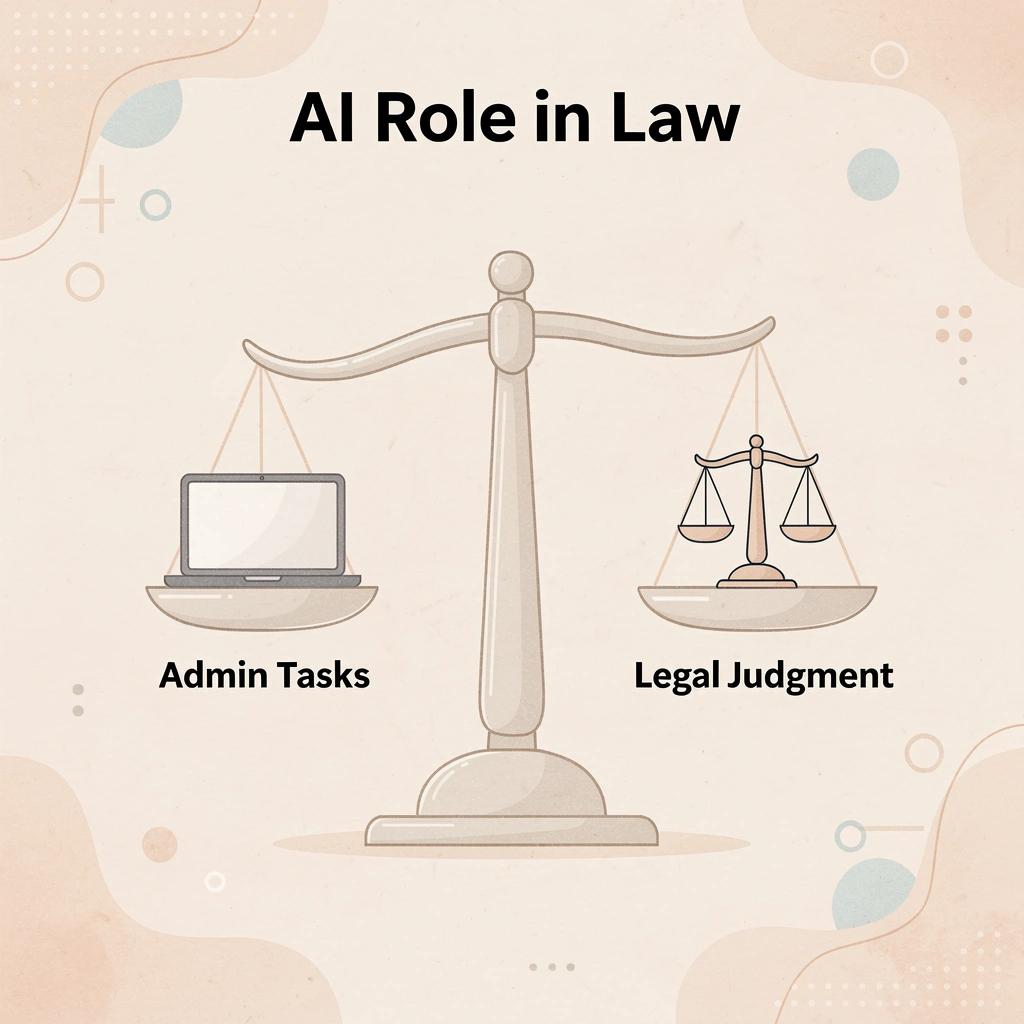
Personal injury law requires legal judgment, negotiation strategy, verified evidence, and client advocacy—responsibilities ChatGPT cannot fulfill. Instead, it eliminates repetitive administrative work that consumes hours weekly. Lawyers keep full responsibility for every legal decision, fact verification, and court filing. The real advantage is removing busywork that prevents deeper case development.
"The greatest benefit of AI tools in legal practice is not replacing attorneys—it's freeing them from administrative bottlenecks so they can focus on high-value legal work." — Legal Technology Industry Insight
🎯 Key Point: ChatGPT handles the repetitive tasks—not the legal ones. Your judgment, strategy, and advocacy remain entirely in your hands.
💡 Tip: Think of ChatGPT as a force multiplier—it doesn't replace your legal expertise; it amplifies how much you can accomplish with it.
- Strategic & Legal Work: Reserved for the Attorney; AI has no role in high-level strategy, factual verification, or final court filings.
- Administrative Tasks: Now offloaded to ChatGPT, which fully assists in streamlining repetitive, manual workloads.
- Drafting & Synthesis: Transitions from Attorney-led to AI-assisted, with ChatGPT handling the initial templates and summaries while the attorney provides the essential final review.
⚠️ Warning: Never use ChatGPT output without attorney review. Every legal decision and filed document demands verified human oversight.
1. Summarizing Medical Records and Creating Chronologies
ChatGPT can process long medical records, bills, and treatment notes to create organized timelines highlighting important dates, diagnoses, procedures, and connections. Lawyers can paste relevant sections and direct the tool to organize them by timeline, provider, or injury category while identifying gaps or inconsistencies. This converts hours of manual review into focused insights supporting demand packages and expert preparation. Attorneys must verify medical interpretations against original documents to maintain accuracy.
2. Drafting Initial Demand Letters
ChatGPT generates complete first drafts of demand letters by organizing accident details, liability arguments, injury impacts, and economic damages into persuasive structures. Provide specifics like police reports, medical summaries, and lost wages, and the tool produces organized sections with clear narratives and supporting calculations. This shortens the typical multi-day drafting cycle, allowing attorneys to focus on refining valuation and negotiation strategy rather than starting from scratch.
3. Preparing Deposition Questions and Outlines
ChatGPT can build targeted lists of questions for plaintiffs, defendants, or treating physicians based on the facts of the case and medical evidence. Prompt it with injury type, disputed issues, and goals such as establishing causation or exposing inconsistencies, and it produces logical sequences with follow-ups. This preparation strengthens examinations in motor vehicle or premises liability cases and improves deposition efficiency when combined with the lawyer's knowledge of jurisdiction and tactics.
4. Generating Client Updates and Plain-Language Explanations
ChatGPT creates clear status updates, settlement explanations, or treatment summaries tailored to client reading levels while maintaining a professional tone. Input case milestones and request simplification of legal or medical concepts, and the tool produces accurate communications that reduce confusion and follow-up calls. This consistency keeps clients engaged throughout long personal injury matters and builds trust.
5. Brainstorming Case Strategy and Valuation Factors
ChatGPT suggests possible arguments, damage elements, or negotiation levers when given anonymized case details and relevant law overviews. It highlights factors such as comparative negligence, future medical needs, and pain-and-suffering multipliers to inform strategy sessions. Lawyers evaluate and adapt these ideas using their experience, as the tool excels at pattern recognition but lacks case-specific judgment and current precedents.
6. Assisting with Client Intake and Initial Case Screening
ChatGPT creates organized intake questions that capture accident details, injury descriptions, insurance information, and liability indicators. Lawyers customize prompts with practice-specific criteria to produce organized scripts or forms that streamline phone or online intakes while flagging high-value or complex cases. This reduces administrative bottlenecks and improves qualification speed, enabling teams to prioritize viable matters quickly. Attorneys review all outputs and conduct final assessments to ensure compliance with ethical intake standards and accurate case evaluation.
7. Supporting Discovery Responses and Document Review
ChatGPT helps lawyers write discovery responses by summarizing documents and finding relevant information for requests for admission or interrogatories. Provide templates and case context, and it will generate responsive language or flag items needing further attention. This accelerates document organization during litigation in personal injury cases where volumes grow quickly. Lawyers must verify that responses are complete, that privileged information is protected, and that all statements are accurate against original materials to protect clients and meet court requirements.
How to Use ChatGPT in a Personal Injury Practice Without Ethical Risks
Using ChatGPT responsibly means combining AI with sound legal judgment, verified legal research, and strong confidentiality practices. The real key is understanding where ChatGPT adds value and where a lawyer's professional responsibility must always take priority.
"The most effective use of AI in legal practice is not replacing professional judgment — it's amplifying it through smarter workflows and rigorous human oversight." — Legal Ethics & Technology Practitioners
💡 Tip: Before using ChatGPT for any client-related task, ask yourself: "Have I verified this output against authoritative legal sources?" If the answer is no, stop and verify first.
⚠️ Warning: Never input identifiable client information into ChatGPT without a firm-approved confidentiality protocol in place. A single data privacy misstep can trigger serious ethical violations and bar complaints.
- Drafting/Templates: ChatGPT speeds up the "blank page" phase; Lawyer's Judgment ensures the final document is legally sound.
- Case Facts: ChatGPT synthesizes raw data; Lawyer's Judgment validates every detail against the official record.
- Legal Arguments: ChatGPT provides creative brainstorming; Lawyer's Judgment confirms viability via verified research.
- Communications: ChatGPT drafts professional phrasing; Lawyer's Judgment maintains ethical tone and privilege.
- Research: ChatGPT identifies potential starting points; Lawyer's Judgment performs the final validation in authoritative databases.
🔑 Takeaway: Responsible AI use in a personal injury practice is not about blind automation — it's about leveraging ChatGPT as a force multiplier while keeping professional responsibility, client confidentiality, and verified legal research at the absolute center of every decision.
Understand Core Ethical Obligations First
Lawyers must base every ChatGPT interaction on professional conduct rules requiring competence, diligence, and confidentiality. Treat the tool as a helper, not a replacement for legal judgment, and ensure careful review of all generated content. Understanding your jurisdiction's rules on technology use in client matters prevents inadvertent violations and the sanctions that have resulted from AI-generated misinformation in prior cases.
Never Input Confidential Client Information
ChatGPT and similar public tools lack built-in protections for sensitive data. Attorneys must omit any details that could identify clients or reveal case specifics, using anonymized hypotheticals or general templates instead. This protects attorney-client privilege, prevents unauthorized data exposure, and avoids ethics complaints or breaches. Personal injury matters, which often involve private medical records and accident details, require particularly strict data hygiene.
Always Verify Accuracy and Citations Independently
ChatGPT can create legal references or summaries that sound real but are inaccurate. You must verify every fact, law, and case citation against primary sources like official reporters or trusted databases. Lawyers who rely solely on the tool risk submitting inaccurate materials and facing court sanctions for uncorrected mistakes. Careful verification demonstrates competence, prevents client harm, and protects professional reputation.
Maintain Human Oversight and Professional Judgment
Think of every ChatGPT output as a first draft requiring editing for legal strategy, tone, and state-specific details. The tool helps generate ideas and organize information, but lacks the real-world knowledge and responsibility of licensed lawyers. This step is critical because rules require lawyers to take responsibility for all work products submitted to clients. In personal injury cases, where settlement amounts and liability depend on precise calculations and compelling arguments, this step is essential.
Document Your Use and Review Processes
Keep clear records of how ChatGPT helped with case work, including the prompts you used and the steps you took to verify the information. This documentation demonstrates compliance during audits or bar inquiries and supports training the team on responsible AI use. Written policies that explain approved uses and prohibited actions help maintain consistency and reduce individual risk across the team.
Choose Secure Tools to Complement ChatGPT
OpenCase provides enterprise-grade privacy protections for AI-assisted legal work, including data encryption, SOC 2 Type II certification, and ISO/IEC 27001 compliance. It integrates with Clio, Google Drive, and Microsoft Word while protecting information and never using it to train external models. This enables personal injury lawyers to extend safe AI practices across document management and case handling without the vulnerabilities of consumer tools.
Train Your Team and Stay Updated on Guidance
Regular training sessions keep staff current on evolving ethics opinions and best practices for generative AI. Subscribe to bar association updates and review resources from organizations addressing technology in legal practice. This equips teams to use ChatGPT with confidence and ethics while adapting to new developments in personal injury workflows.
How OpenCase Complements ChatGPT in a Legal Workflow
Splitting tasks between the right tools separates a productive legal workflow from a risky one. ChatGPT drafts fast — it structures arguments, summarizes records, and generates first-pass correspondence at a pace no associate can match. But drafting speed and legal accuracy are different problems, and mixing them up is where practices get into trouble.
"Drafting speed and legal accuracy are different problems — and mixing them up is where practices get into trouble."
- First-pass drafting: ChatGPT excels at high-speed structuring and professional tone.
- Legal accuracy: OpenCase is superior for jurisdiction-aware, precise legal application.
- Summarizing records: ChatGPT efficiently synthesizes massive volumes of correspondence.
- Cite-checking: OpenCase minimizes malpractice risk by ensuring verified compliance.
🎯 Key Point: The real competitive advantage isn't choosing between ChatGPT and OpenCase — it's knowing exactly which tool owns which part of your workflow.
💡 Tip: Use ChatGPT to generate your first draft, then route it through OpenCase for legal validation before it ever reaches a client or court. This two-step approach captures the best of both tools while eliminating the blind spots each carries on its own.
⚠️ Warning: Relying on ChatGPT alone for legal output is one of the most common — and costly — mistakes modern practices make. Speed without jurisdictional accuracy isn't efficiency; it's liability.

Why does AI hallucination put personal injury lawyers at risk?
The failure point is usually invisible until it isn't. Attorneys who sign AI-drafted memoranda without reviewing underlying sources trust a tool that sounds authoritative, a dynamic that has led to sanctioned filings, fabricated case names in official court records, and attorneys barred from appearing in court. One attorney testified she did not know AI could fabricate sources—a knowledge gap that unverified general-purpose tools actively reinforce, since they never signal when they are guessing.
How does a verified research layer fix what ChatGPT misses?
Legal research tools built for a specific purpose operate on a different principle: every answer must connect to a primary source. Most attorneys manually verify AI output against Westlaw or Lexis after the fact, a time-consuming process that relies on catching errors. As caseloads grow, that manual verification becomes the first step skipped. Legal AI like OpenCase takes a different approach, searching across 100-plus legal databases, including Cornell LII statutes, Supreme Court opinions, federal and state indexes, and verified government PDFs, so that checked citations are built into the research output rather than added afterward.
Law firms using AI-assisted workflows report saving 6 or more hours per attorney per week, but only if the workflow is set up correctly. Hours saved on drafting disappear when attorneys spend the same amount of time fixing fabricated citations or responding to sanctions motions. The efficiency gain requires pairing a drafting tool with a verification layer, rather than using a single tool for both tasks.
Is ChatGPT good for personal injury lawyers when used alongside dedicated legal research tools?
The American Bar Association's 2024 Legal Technology Survey found that AI adoption in law firms nearly tripled from 11% in 2023 to 30% in 2024. This rapid adoption means more lawyers are using AI before understanding its limitations. A personal injury lawyer using ChatGPT to write a liability narrative makes a smart workflow choice. That same lawyer, using ChatGPT to find controlling precedent in a jurisdiction-specific negligence case, takes a risk that no client engagement letter covers.
The workflow that holds up under court scrutiny looks like this: ChatGPT handles volume work—drafts, summaries, correspondence. A verified legal research platform handles citations, statutory grounding, and source traceability. Neither tool replaces the attorney's judgment, but together they protect it.
Related Reading
- Best Ai Contract Review Tool
- Ivo
- ChatGPT For Lawyers
- Clio
- Spellbook
- Everlaw
- Harvey
- Legora
- Law Insider
Try our Legal AI to Support your Legal Work from Research to Final Draft
ChatGPT gets you partway there: fast drafts, organized timelines, cleaner correspondence. But partway isn't enough when a citation error triggers sanctions or a data handling gap compromises client confidentiality. Attorneys pulling ahead pair ChatGPT with platforms where every source traces back to verified primary law.
"A citation error or data handling gap isn't a mistake—it's a liability. The attorneys pulling ahead pair AI speed with verified primary law." — OpenCase
🎯 Key Point: Standalone AI tools like ChatGPT are powerful starting points but lack the source verification and confidentiality safeguards that legal work demands.
⚠️ Warning: Relying on unverified AI output for legal filings risks sanctions, malpractice exposure, and client confidentiality breaches—gaps no attorney can afford to leave open.

OpenCase closes that gap. Our platform searches 100-plus legal databases grounded in Cornell LII statutes, Supreme Court opinions, and authenticated government records, so your research stands on solid ground before filing. Native integrations with Clio, Microsoft Word, and Google Docs, plus encryption in transit and at rest, solve the confidentiality and fragmentation problems standalone AI tools leave open. Start your free exploration today.
- Source Verification: ChatGPT is unverified; OpenCase links directly to official legal databases (LII, SCOTUS).
- Database Access: ChatGPT has limited legal depth; OpenCase integrates with 100+ specialized sources.
- Data Security: ChatGPT lacks guaranteed privacy; OpenCase ensures end-to-end encryption (in-transit/at-rest).
- Workflow: ChatGPT requires manual exports; OpenCase integrates directly into Clio, Word, and Docs.
- Filing Readiness: ChatGPT needs heavy verification; OpenCase provides court-ready primary law.
🔑 Takeaway: OpenCase isn't just another AI tool — it's the verification layer that transforms AI-assisted drafts into filing-ready legal work, backed by authenticated sources and built for attorney-grade confidentiality.