10 Best AI Contract Review Tools for Law Firms in 2026
Find the best AI contract review tool for your firm. OpenCase breaks down 10 options, saving lawyers hours on every deal.

Contract review is one of the most time-consuming tasks in law practice management, and even experienced attorneys can miss critical details when working through lengthy agreements under pressure. Firms that rely on manual analysis often flag risks too late, spend hours on repetitive clause-by-clause review, and struggle to keep pace with growing caseloads.
The right AI tool changes that equation significantly. Several strong options now exist to help legal teams review contracts faster, surface hidden risks earlier, and reduce the manual workload that slows productivity. For firms ready to modernize how they handle agreements, OpenCase offers a practical starting point worth exploring through legal AI.
Table of Contents
- What Is an AI Contract Review Tool and How Does It Work?
- Why Are Law Firms Using AI Contract Review Tools?
- Is AI Contract Review Secure for Confidential Legal Documents?
- 10 Best AI Contract Review Tools for Law Firms in 2026
- How to Choose the Best AI Contract Review Tool for Your Law Firm
- Why OpenCase Is a Strong Choice for Modern Law Firms
- Try our Legal AI to Support your Legal Work from Research to Final Draft
Summary
- AI contract review tools can reduce contract review time by up to 80%, according to ContractSafe. That efficiency gain does not eliminate attorney judgment. It redirects it toward negotiation strategy, client counsel, and decisions that require trained legal reasoning rather than manual clause scanning.
- Adoption of AI in legal practice is accelerating faster than most firms anticipated. The ABA Legal Technology Survey found that 30% of legal professionals now use AI, up from just 11% in 2023. The primary driver is not internal enthusiasm for technology but external pressure from clients who expect faster turnaround on routine agreements.
- Poor contract management carries a measurable financial cost. Docusign estimates that organizations lose approximately 9.2% of annual revenue due to inadequate contract oversight. That figure reflects what unreviewed or misread clauses actually cost in practice, not just in theory, and it makes a strong case for structured, consistent review processes.
- Security concerns remain the dominant barrier to AI adoption in legal settings. Axiom Law's 2025 research found that 39% of legal professionals cite data security and confidentiality as their top concern, and 72% of legal teams now require vendor confirmation that uploaded documents are not used to train AI models before adopting any contract review tool. Consumer-grade tools were not designed with attorney-client privilege in mind, and the gap between their default behavior and legal professional standards is significant.
- The revenue case for AI-assisted legal work is now supported by data. The 2025 Clio Legal Trends Report found that law firms using AI earn more per client and per case than firms that do not use AI. Firms using these tools can absorb greater matter volume without proportional increases in headcount, which changes the economic model of legal service delivery.
- Verifiable citations matter as much as speed. A Thomson Reuters and Forrester study found that firms using AI can handle 25% more matter capacity, but that gain disappears if attorneys must manually verify whether AI-generated clause interpretations reflect current law. The efficiency math only holds when outputs trace back to primary sources from the start.
- OpenCase legal AI addresses this by grounding every clause analysis and legal research output in verified primary law records from sources such as Cornell LII, CourtListener, and govinfo, so attorneys can act on what the platform surfaces without having to separately validate each result.
What Is an AI Contract Review Tool and How Does It Work?
AI contract review tools are software made for a specific purpose. They read, interpret, and analyze legal agreements on their own. They understand clause relationships, flag places where the language is different from the standard, and show risk much faster than a human reviewer could.
💡 What It Does: An AI contract review tool doesn't just scan for keywords — it actively understands clause relationships, detects non-standard language, and surfaces risk signals that would take a human reviewer significantly longer to identify.
Reads Legal Agreements Autonomously
What It Means for You
- Eliminates the need for manual document parsing
Understands Clause Relationships
What It Means for You
- Identifies how one contract clause affects another
Flags Non-Standard Language
What It Means for You
- Highlights deviations from your firm's approved playbook or templates
Surfaces Risk Faster
What It Means for You
- Prioritizes potential issues before human review begins
"AI contract review tools can cut the time it takes to review a contract by up to 80%." — ContractSafe
According to ContractSafe, AI contract review tools can cut the time it takes to review a contract by up to 80%. A document that once took an attorney a whole morning can be processed before a second cup of coffee. That time can then be used for more important work: negotiation strategy, client advice, and decisions that need trained legal judgment.
⚠️ Don't Mistake Speed for Replacement: AI handles the heavy lifting of initial review — but critical decisions around negotiation strategy and legal judgment still require a trained human attorney.
How does the best AI contract review tool parse a document?
The process starts with document ingestion. The tool extracts clean text from PDFs, Word files, and scanned images using optical character recognition, preserving structural elements like numbering and headings. Natural language processing models then break the document into individual clauses and categorize each by type: indemnification, limitation of liability, confidentiality, and termination rights. The models detect subtle differences in meaning by reading the surrounding context the way a trained attorney would.
How does AI contract review eliminate inconsistency at volume?
When junior associates manually review contracts, consistency issues arise at scale. If the same clause appears in fifty contracts reviewed by five different people, each may interpret it differently. AI contract review tools apply the same standard consistently, comparing extracted clauses against your organization's playbook and flagging differences. The risk assessment output is structured, traceable, and audit-ready. OpenCase grounds its analysis in verified primary law records, so flagged clauses can be traced back to actual statutes and case law rather than a model's best guess.
What the output actually gives you
These tools extract structured information such as party names, key dates, renewal terms, payment obligations, and governing law, then create plain-language summaries that make complex provisions accessible to business stakeholders without legal training.
What does the best AI contract review tool surface in its output?
Output typically includes suggested changes, suggested additions for missing clauses, and risk-level ratings linked to relevant contract text. According to the DocuSign Blog, organizations lose an estimated 9.2% of their annual revenue due to poor contract management. Human reviewers approve, refine, or override every suggestion, preserving human judgment while eliminating manual scanning.
How does the best AI contract review tool meet legal trust standards?
The tools that earn trust in a legal environment are verifiable, secure, and built to meet professional liability standards.
Why Are Law Firms Using AI Contract Review Tools?
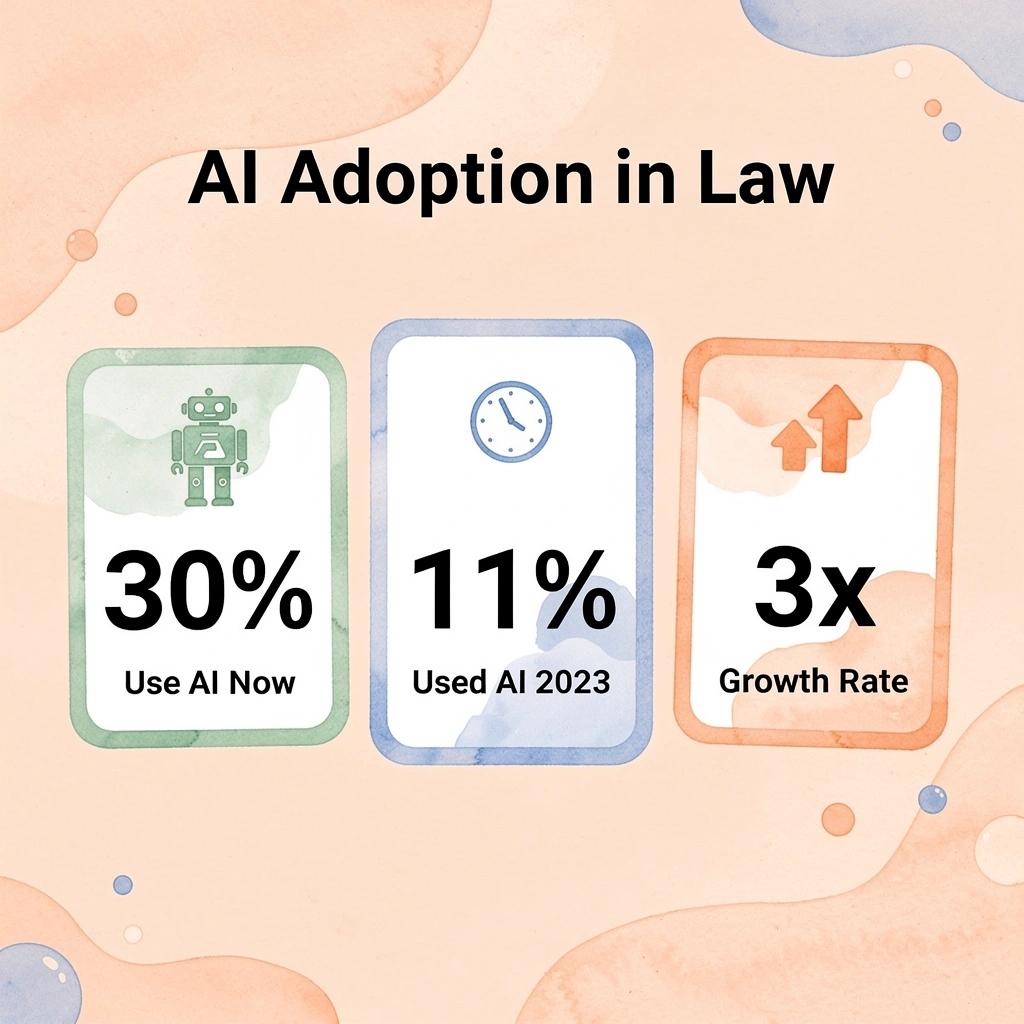
According to the ABA Legal Technology Survey via LawNext, 30% of lawyers now use AI technology, up from just 11% in 2023 — a nearly threefold increase in just two years. This shows a big change in how law firms think about getting work done, handling risks, and staying competitive.
"30% of lawyers now use AI technology, up from just 11% in 2023 — signaling a fundamental shift in how the legal industry approaches efficiency and risk management." — ABA Legal Technology Survey via LawNext, 2025
🔑 Takeaway: A jump from 11% to 30% in just two years isn't a trend — it's a transformation. Law firms that delay AI adoption risk falling behind competitors who are already working faster and smarter.
💡 Why It Matters: AI contract review tools are a primary driver of this surge, helping firms cut review time, reduce human error, and handle higher contract volumes without scaling headcount.
2023
Lawyers Using AI
- 11%
Growth
- Baseline
2025
Lawyers Using AI
- 30%
Growth
- +173% increase compared with 2023
What's actually pushing firms to move
The pressure isn't coming from technology fans inside firms—it's coming from clients. Corporate legal departments now understand what they're paying for and question why simple vendor agreements take two weeks and cost thousands of dollars in fees to close. Manual review at that speed becomes a problem in deal-making situations where timing changes result. Firms that can't match the speed lose work to competitors who can.
Where does the bottleneck actually appear in contract work?
The same issue arises in high-volume commercial practices and M&A due diligence: the bottleneck is not attorney judgment but the hours spent confirming that standard clauses are present and compliant before analysis begins. AI contract analysis tools handle that initial pass, flagging missing provisions, inconsistent language, and deviations from playbook standards before a senior attorney opens the document. This frees attorneys to focus on clauses that require legal reasoning rather than those that only need to be located.
Why does the best AI contract review tool need verified legal sources?
Most firms start by routing contracts through general-purpose AI tools because they're familiar and easy to access. The problem emerges when those tools generate clause interpretations or legal references that can't be traced to verified sources. A suggestion citing a misquoted statute or non-existent precedent doesn't save time; it creates a new review burden and potential malpractice exposure. OpenCase addresses this by grounding its legal AI in verified primary law records from sources such as Cornell LII, CourtListener, and govinfo, so attorneys can act on what the platform surfaces without having to validate every output separately.
Why is adoption accelerating now?
The 2025 Clio Legal Trends Report via 2Civility found that law firms using AI generate more revenue per client and per case than those without it. AI contract review isn't about cutting costs; it's about increasing profits. Firms using these tools can handle more work without proportional increases in headcount, improving margins while delivering faster results to clients who increasingly prioritize speed.
What separates tools built for legal from those adapted after the fact?
Contract review tools seeing serious use in legal environments are built to meet the verification and security standards that professional liability demands, rather than adapted from consumer-grade products. That distinction matters more than any individual feature comparison.
The question that keeps general counsel and managing partners awake is whether documents flowing through these platforms are safe.
Related Reading
- Law Practice Management
- Google Gemini For Lawyers
- Claude vs. ChatGPT for Lawyers
- ChatGPT Prompts For Lawyers
- Copilot For Lawyers
- Ai Use Cases For Lawyers
- Ai Legal Hallucinations
- Legal Tech Trends
- Prompt Engineering For Lawyers
- Legal Writing Ai
- Claude For Lawyers
- Ai Legal Ethics
Is AI Contract Review Secure for Confidential Legal Documents?
Security in AI contract review must be built into the design from the start—it cannot be added later. The best tools treat every document as evidence in a live case because, for your clients, it often is.
"Security in AI contract review must be built into the design from the start—it cannot be added later." — WJARR, 2025
🚨 Warning: Choosing an AI contract review tool without security built into its core architecture is a critical risk to client confidentiality and your firm's reputation.
🔑 Takeaway: The gold standard for AI-powered legal tools is treating every uploaded document with the same rigorous protection as live case evidence—because that's what it may be.

What makes the security question so urgent
According to Axiom Law's 2025 research, 39% of legal professionals cite data security and confidentiality as their primary concern when using AI tools. This concern reflects a gap between how companies market these platforms and how they handle data. The critical question is what happens to confidential NDAs or acquisition term sheets once they leave your firm and pass through another's computer system.
Why do consumer-grade AI tools put privileged documents at risk?
Public AI services often retain uploaded content to improve their models without creating reviewable logs. Language from sensitive deals can become part of a model's training set, accessible in fragmented form to future users. This is the documented default behavior of consumer-grade tools, never designed with the attorney-client privilege in mind.
What should the best AI contract review tool guarantee about model training?
Most firms review the platform's privacy policy and assume encryption is enough. But AI platforms introduce a different risk: the model itself becomes problematic. Axiom Law's 2025 findings show that 72% of legal teams now require vendors to confirm that documents are not used to train AI models before adopting contract review tools. This reflects a growing understanding of how the technology works.
What responsible contract review security actually looks like
Purpose-built legal AI platforms address this through zero-retention agreements, no-training clauses, AES-256 encryption at rest, TLS 1.3 in transit, SOC 2 Type II audits, and role-based access with full audit logging. These features distinguish tools built for legal environments from those adapted from consumer products. Platforms like OpenCase ground outputs in verified primary law records, so every research result or clause analysis traces back to a citable, auditable source rather than a model's probabilistic inference.
Why does data residency matter when choosing the best AI contract review tool?
Data residency adds another layer that most firms underestimate until they face a cross-border matter. AI processing frequently routes documents through cloud infrastructure optimized for global scale, not jurisdictional compliance. Without explicit contractual commitments to named geographic regions and defined deletion protocols, a contract uploaded in Sydney or Frankfurt may be processed in a jurisdiction with entirely different data sovereignty rules. GDPR exposure and Australian Privacy Principle violations do not care about intent.
Can you actually prove your AI contract review tool is secure?
The question that should follow every security conversation about AI contract review is not "Is this tool secure?" but "Can I prove it, and to whom?" The answer matters differently to a bar disciplinary board than to a client whose acquisition documents appeared in discovery.
Related Reading
- Law Firm Marketing
- Lawyer Salary
- How To Use ChatGPT for Legal Research
- Iolta Account
- Is ChatGPT Good For Personal Injury Lawyers
- Law Clerk
- Legal Ai Tools
- Will Lawyers Be Replaced By Ai
- Billable Meaning
- Law Firm Seo
- Objections In Court
- Legal Billing Software
10 Best AI Contract Review Tools for Law Firms in 2026
AI contract review tools help law firms dramatically review contracts faster, reduce manual work, improve consistency, and deliver accurate legal analysis. The best tools identify risky clauses, compare agreements against internal standards, summarize lengthy contracts, and streamline workflows — all while keeping lawyers in control. Below are the top AI contract review tools for 2026, starting with OpenCase.
"AI contract review tools help law firms reduce manual work, improve consistency, and deliver accurate legal analysis — transforming how legal teams handle contracts at scale."
💡 Tip: When evaluating any AI contract review tool, prioritize platforms that identify risky clauses and compare agreements against your firm's internal standards — these two features alone can save hours of manual review per contract.
⚠️ Warning: Not all AI contract tools are built equally. The most critical distinction is whether the platform keeps lawyers in control of final decisions, rather than replacing human legal judgment entirely.
Risky Clause Identification
Why It Matters
- Flags high-risk contract language before it becomes a liability
Internal Standard Comparison
Why It Matters
- Ensures contracts remain consistent with firm-approved templates and policies
Contract Summarization
Why It Matters
- Reduces review time for lengthy and complex agreements
Workflow Streamlining
Why It Matters
- Keeps the entire legal team aligned, efficient, and productive
1. OpenCase
OpenCase provides law firms with a secure, AI-powered platform for contract review, drafting, research, and citations. Built on trusted legal data sources such as Cornell LII and official government archives, it delivers fast, verifiable insights while prioritizing client confidentiality through robust protections that prevent data leaks and privilege waivers.
Key Features for Contract Review
- Microsoft Word plugin that lets you draft contracts in the document, redline with tracked changes, and conduct final reviews without leaving the familiar interface.
- Playbook and template integration for consistent, firm-standard contract analysis and generation.
- Jurisdiction-specific review drawing from authoritative U.S. statutes, Supreme Court opinions, and PACER dockets.
- Secure file and folder ingestion supporting contract analysis with configurable page limits.
- Citation verification ensures every insight traces back to primary law sources for accuracy and defensibility.
- Real-time risk flagging for missing clauses, inconsistencies, or non-standard terms during review.
- AI-assisted summarization and plain-language explanations of complex contract provisions.
- Team collaboration tools, including shared projects, playbooks, and chat history, enable coordinated reviews.
- Daily PACER docket and filing ingestion for up-to-date context in contract-related research.
- Configurable data retention policies and private data isolation ensure that uploads never train external models.
- Audit-ready logs and governance aligned with ISO 42001 for compliance in high-stakes reviews.
Pros
- Exceptional security with SOC 2 Type II, ISO 27001, AES-256 encryption, TLS 1.3, and US-only data centers (including AWS GovCloud) safeguards confidential documents and preserves attorney-client privilege.
- Seamless Word integration eliminates context switching, reducing review time and associate burnout while boosting billable efficiency.
- Traceable, verifiable outputs from trusted legal corpora reduce errors and build client trust through transparent reasoning.
- Flexible scaling from the free tier to the enterprise addresses volume pressures without forcing headcount increases.
- Playbook enforcement delivers consistency among reviewers, mitigating the risk of deviation on repeat client matters.
- Built-in research and citation tools combine review with analysis, speeding up due diligence and negotiation preparation.
- Strong focus on responsible AI governance and private isolation counters data breach and training concerns.
Cons
- As a focused legal AI platform, it prioritizes review and research depth over broader practice management functions.
Accessibility
Free Basic plan with limited daily questions and pages; Pro plan at $99 per seat/month (billed annually); Enterprise plan with custom pricing, advanced features, dedicated support, API access, and custom SLAs.
2. LegalOn
LegalOn earns recognition as a top performer in contract review through its playbook-driven automation and consistent risk flagging. It directly solves inconsistency across reviewers and slow turnaround by applying firm-specific standards at scale, while maintaining auditability to protect privilege and reduce malpractice exposure.
Key Features
- Attorney-drafted playbooks for standardized redlining and deviation detection.
- AI agents for intake, triage, review, and drafting under human supervision.
- Clause extraction, risk scoring, and missing provision identification.
- Legal-grade translation and jurisdiction handling.
- Portfolio-wide insights and obligation tracking.
- Integration with common legal tech stacks.
- Detailed audit logs and approval workflows.
Pros
High accuracy on commercial contracts with reported productivity gains; strong consistency reduces errors from fatigue; supports full lifecycle elements beyond pure review.
Cons
Enterprise-oriented pricing and implementation may not suit very small firms; they require an initial playbook setup investment.
Accessibility
Custom enterprise pricing; contact sales for demos and tailored plans.
3. Spellbook
Spellbook integrates deeply into Microsoft Word to streamline transactional work for law firms. It addresses billable-hour pressure and repetitive tasks by offering real-time suggestions and redlining directly within documents, freeing associates to focus on strategic work.
Key Features
- Native Word integration for drafting and review.
- Clause suggestions and real-time risk flagging.
- Playbook enforcement and market standard comparisons.
- Redline generation with explanations.
- Document summarization and key term extraction.
- Training on legal agreements for higher relevance.
- Collaboration tools within the familiar interface.
Pros
Minimal learning curve for Word users; speeds up drafting and review significantly; focused on transactional lawyers.
Cons
Less emphasis on massive due diligence portfolios compared to enterprise CLM tools; subscription costs add up for large teams.
Accessibility
Starts around $99/user/month with higher tiers; free trial available.
4. Kira Systems (Litera)
Kira excels in large-scale extraction and analysis, ideal for M&A due diligence in law firms. It tackles volume overload and oversight risks by quickly processing thousands of documents using customizable models, delivering structured outputs that accelerate team reviews.
Key Features
- 1,000+ pre-built smart fields for clause extraction.
- Custom model training on firm data.
- Bulk document processing for due diligence.
- Risk and anomaly detection.
- Integration with the broader Litera suite.
- Reporting and visualization dashboards.
- High accuracy on provision types.
Pros
Proven at enterprise scale with strong customization; excellent for high-volume matters.
Cons
Steeper implementation for smaller firms; focused more on extraction than full drafting assistance.
Accessibility
Enterprise pricing, typically quote-based with significant annual commitments.
5. Ironclad
Ironclad combines contract review with full lifecycle management, helping law firms and their clients maintain control from intake to execution. It solves workflow fragmentation and post-signature obligation misses through AI-powered playbooks and approvals.
Key Features
- AI clause detection and smart import.
- Workflow designer for approvals and negotiations.
- Playbook-driven redlining.
- Obligation and renewal tracking.
- Repository with search and analytics.
- Integrations with Office 365 and more.
- Custom AI clauses and properties.
Pros
End-to-end visibility reduces post-review surprises and is strong for collaborative client work.
Cons
More CLM-focused, so pure review users might find extra features overwhelming; enterprise-scale pricing.
Accessibility
Custom enterprise pricing; contact sales.
6. Harvey AI
Harvey AI delivers high-accuracy analysis tailored for complex matters in large law firms. It addresses nuanced risk detection and strategic decision support by combining advanced models with firm-specific data, reducing missed high-stakes provisions while accelerating due diligence and review cycles.
Key Features
- Proprietary legal fine-tuning for 97-99% risk detection accuracy.
- Bulk document analysis with low false positives.
- Conversational querying across contracts.
- Custom agent creation for firm workflows.
- Integration with existing legal tech ecosystems.
- Detailed explanations and source citations.
- Scalable processing for thousands of pages.
Pros
Exceptional performance on complex, non-standard terms; trusted by AmLaw 100 firms; strong reasoning capabilities.
Cons
Premium enterprise pricing with minimum seat requirements; best suited for larger teams with dedicated implementation.
Accessibility
Custom enterprise pricing, often $1,000+ per seat/month with volume commitments.
7. Luminance
Luminance focuses on intelligent pattern recognition and auto-redlining for high-volume reviews. It tackles inconsistency and fatigue in M&A or portfolio work by learning from document sets and providing visual, actionable insights that speed up human oversight.
Key Features
- AI-driven clause identification and anomaly detection.
- Auto-markup and redline suggestions.
- Portfolio-level comparisons.
- Self-learning from reviewed documents.
- Visual analysis interfaces.
- Risk prioritization scoring.
- Integration with data rooms and CLM systems.
Pros
Excellent for large-scale due diligence, it dramatically reduces manual effort for repeat clause types.
Cons
May require more setup for highly customized playbooks; less emphasis on day-to-day drafting.
Accessibility
Enterprise quote-based pricing; demo available.
8. ContractPodAi (with Leah AI)
ContractPodAi emphasizes generative AI for end-to-end contract processes. It solves compliance and speed issues by automating review, drafting, and negotiation while embedding governance to maintain security and consistency across the firm.
Key Features
- Leah AI for generative review and drafting.
- Playbook and clause library management.
- Vendor negotiation portal.
- Obligation extraction and tracking.
- Advanced analytics and reporting.
- Secure repository with AI search.
- Workflow automation and approvals.
Pros
Comprehensive platform beyond review; strong AI governance features; good for transforming legal operations.
Cons
A broader CLM scope may feel heavy for firms seeking only a lightweight review tool.
Accessibility
Enterprise custom pricing.
9. Robin AI
Robin AI provides conversational, agentic support for contract negotiation and review. It helps firms reduce outside counsel spend and internal bottlenecks by offering plain-language insights and automated redlines grounded in playbooks.
Key Features
- Natural language contract querying.
- Automated redlining and fallback suggestions.
- Playbook integration for consistency.
- Negotiation email and summary generation.
- Risk flagging with explanations.
- Collaboration tools for teams.
- Jurisdiction and regulation awareness.
Pros
User-friendly conversational interface; effective for mid-size firms; accelerates negotiation cycles.
Cons
May not match the extraction depth of pure due diligence tools for massive portfolios.
Accessibility
Custom pricing, typically starting in the hundreds per month; contact for details.
10. CoCounsel (Thomson Reuters)
CoCounsel leverages trusted legal research foundations for contract analysis. It addresses verification burdens and research integration needs by combining review with citation-checked insights, helping firms maintain accuracy while speeding up complex matters.
Key Features
- Conversational review tied to Westlaw/Practical Law.
- Clause extraction and risk analysis.
- Drafting assistance with verified language.
- Research integration within a contract context.
- Audit-ready outputs and summaries.
- Team collaboration features.
- High compliance and security standards.
Pros
Backed by established legal content for reliability, seamless for firms already in the Thomson Reuters ecosystem, strong on research-heavy reviews.
Cons
Higher cost for standalone use; benefits maximized within broader TR subscription.
Accessibility
Starts around $225/user/month; often bundled; contact sales for exact pricing.
How to Choose the Best AI Contract Review Tool for Your Law Firm
Picking an AI contract review tool is a big technology choice for the long term. The right platform should review contracts faster, make results more consistent, cut down on manual work, and make legal accuracy stronger without getting in the way of how you already work. Think about how well it fits your law firm's legal practice, security needs, and everyday operations.
"The right AI contract review platform doesn't just speed up review — it strengthens legal accuracy, reduces risk, and integrates seamlessly into your firm's existing workflow." — Legal Technology Best Practices
🎯 Key Point: The best AI contract review tool for your firm is not simply the most feature-rich option — it's the one that aligns with your specific legal practice, security requirements, and operational workflows without disrupting your team.
Contract Review Speed
Why It Matters
- Reduces turnaround time and lowers attorney workload
Result Consistency
Why It Matters
- Minimizes human error across high-volume contract reviews
Security & Compliance
Why It Matters
- Protects sensitive client data while meeting regulatory requirements
Workflow Integration
Why It Matters
- Enables adoption without disrupting existing legal workflows
Legal Accuracy
Why It Matters
- Delivers professional-grade results your firm can rely on
⚠️ Warning: Never choose an AI contract review tool based on price alone — a platform that doesn't fit your firm's security standards or practice area needs can create far greater costs in risk and rework down the line.

Assess Your Firm’s Current Pain Points and Volume
Map daily challenges: hours spent on manual line-by-line reviews, frequent oversights in high-volume due diligence, inconsistent redlines across team members, and security concerns around confidential uploads. Calculate metrics like average contracts per month, document complexity, and team size to identify must-have features. Small transactional practices benefit from seamless Microsoft Word integration and quick playbook enforcement, while large firms handling M&A need strong bulk processing and portfolio analytics. This assessment prevents overpaying for unused enterprise features or underinvesting in tools that fail to address core bottlenecks.
Prioritize Security and Confidentiality Protections
Security is non-negotiable for handling privileged client data. Demand SOC 2 Type II compliance, ISO 27001 certification, AES-256 encryption at rest, TLS 1.3 in transit, private data isolation with explicit no-training guarantees, and US or jurisdiction-specific data residency options. Verify audit logs, configurable retention policies, and contracts treating the vendor as a data processor. Tools lacking these expose firms to privilege-waiver risks—as seen in court rulings on public AI platforms—and to potential breaches that damage reputations and invite regulatory penalties. Always request a data processing agreement and conduct vendor due diligence before uploading sensitive agreements.
Evaluate Core AI Capabilities and Accuracy
Test clause extraction, risk flagging, deviation detection against custom playbooks, missing provision identification, and redline suggestions. Prioritize legal-domain training, citation traceability to primary sources, low false-positive rates, and jurisdiction-specific analysis support. Enterprise solutions like OpenCase achieve 90%+ accuracy on standard provisions through fine-tuning, while integrating with trusted databases such as Westlaw or official archives enhances reliability. Request demos with your sample contracts to confirm the tool reduces review time without introducing hallucination errors.
Check Workflow Integration and Usability
The best tools fit into existing workflows rather than forcing change. Focus on solutions that work directly with Microsoft Word for real-time editing and integrate with contract management systems, SharePoint, or practice management software. Intuitive interfaces, straightforward support, team collaboration features, and minimal training requirements drive adoption. Solutions that track changes, provide plain-language summaries, and support audit trails enable associates to focus on strategy rather than paperwork, improving billable efficiency and reducing burnout.
Review Scalability, Pricing, and Support
Look at different pricing levels: per-person costs versus company-wide fees, and expenses for handling increased workload or adding users. Free or starter plans suit solo lawyers, while medium-sized law firms need scalable pricing without steep jumps. Consider implementation support, ongoing training, customer support resources, and service-level agreements covering uptime and response times. Strong vendors provide clear return-on-investment metrics, such as time savings, reduced outside-counsel spending, and avoided errors, that justify the cost. Avoid tools that charge extra for advanced features your practice requires.
Test for Compliance, Customization, and Future-Proofing
Ensure the platform aligns with your regulatory environment through GDPR readiness, HIPAA compliance where applicable, and customizable playbooks that adapt to your firm's standards. Evaluate update frequency, responsible AI governance (such as ISO 42001 alignment), and roadmaps for features like agentic workflows. Strong vendors offer trial periods, proof-of-concept projects using your data, and references from comparable law firms.
Why OpenCase Is a Strong Choice for Modern Law Firms
It is harder to prove that something follows the rules after it is already built than to build it the right way from the start. Most tool evaluations skip over the critical difference between a platform that says it is secure and one that can show it is secure through independently verified architecture.
"The critical difference between a platform that says it is secure and one that can show it is secure through independently verified architecture is not a minor distinction — it is the entire foundation of trust."
🎯 Key Point: Security claims are not the same as security proof — always demand independently verified architecture before committing to any platform.
⚠️ Warning: Most tool evaluations fail to ask the most important question: can this platform demonstrate compliance through verified evidence, or is it relying on unaudited self-reporting?
The Platform Says It Is Secure
What It Reveals
- Unverified claims only
The Platform Shows It Is Secure
What It Reveals
- Independently verified security architecture
Built Securely from the Start
What It Reveals
- Proactive compliance and security by design
Security Added After the Fact
What It Reveals
- Reactive patching with higher long-term risk

What security blind spot do most AI contract review tool evaluations miss?
The failure point is typical: firms evaluate AI contract-review tools based on speed and interface, only to discover the data governance question when something goes wrong. Attorneys testing multiple platforms report the same cycle. A tool looks capable until you ask where uploaded agreements are stored, who can access them, and whether those answers change if the vendor gets acquired or moves its infrastructure. By then, privileged documents had already been disclosed to unauthorized parties.
Why should security evaluation come before workflow design for the best AI contract review tool?
Most teams add a security review step after selecting their preferred tool. By the time the security team flags concerns, the workflow is built around the tool, adoption has started, and reversing course creates organizational friction that often kills the review entirely. Firms that conduct the security evaluation first, before workflow design, avoid that trap. OpenCase is built with that sequence in mind: SOC 2 Type II compliance, ISO 27001 certification, and explicit guarantees that uploaded documents never train underlying models, all verifiable before a single contract is processed.
What does verifiable accuracy actually cost?
The citation question deserves the same careful attention as the security question. A tool that produces fast answers you cannot trace to sources creates a different problem than a slow tool. According to a Thomson Reuters and Forrester study on CoCounsel Legal, firms using AI can handle 25% more matter capacity, but that gain disappears if attorneys spend their saved time manually verifying whether AI-generated clause interpretations reflect current law. The economics work only when citations are traceable to primary sources from the start.
How does source traceability separate the best AI contract review tool from the rest?
When a lawyer is negotiating an indemnification clause at 11 pm before a closing, they need to know whether the AI's suggested language reflects actual case law or a plausible-sounding reconstruction of it. Platforms grounded in verified sources like Cornell LII statutes, Supreme Court opinions, and PACER dockets give lawyers something to stand behind. Platforms that cannot trace their outputs to primary law records leave lawyers with something to explain later.
Does verified citation access have to be a BigLaw budget item?
TheLawGPT's comparison of OpenCase notes that OpenCase charges $82 per month for U.S.-only legal research, making enterprise-grade citation verification accessible to non-BigLaw firms. The professional liability risk of unverified AI output remains constant regardless of firm size.
When the tool you choose is tested before a disciplinary board, will you be able to show your work?
Related Reading
- Legora
- Clio
- ChatGPT For Lawyers
- Ivo
- Harvey
- Spellbook
- Law Insider
- Everlaw
Try our Legal AI to Support your Legal Work from Research to Final Draft
Showing your work is no longer optional. When a disciplinary board, client, or senior partner asks how a legal conclusion was reached, "the AI said so" is not an answer. The standard is traceable authority, and your tools must meet it.
"The standard is traceable authority — and your tools must meet it."
🚨 Warning: Relying on unverified AI outputs without cited primary-source authority exposes your firm to disciplinary risk, malpractice liability, and a fundamental breakdown of client trust.
🔑 Takeaway: Every legal conclusion your team reaches must be backed by verifiable, traceable sources, not an AI-generated response with no paper trail.

OpenCase combines AI-powered legal research with verified citations from primary sources, integrated into Microsoft applications your attorneys already use, at a price point accessible to firms of any size. Review contracts faster, draft stronger documents, and verify every legal authority without switching platforms or second-guessing outputs. Request access today.
AI-Powered Legal Research
What It Means for Your Firm
- Faster, deeper legal research without manual source hunting
Verified Citations from Primary Sources
What It Means for Your Firm
- Every conclusion is traceable, verifiable, and defensible
Microsoft Integration
What It Means for Your Firm
- Works directly within the Microsoft tools your attorneys already use
Accessible Price Point
What It Means for Your Firm
- Designed to be affordable for firms of all sizes—not just large law firms
💡 Tip: The best legal AI tools don't just generate answers — they show exactly where those answers come from, so you can defend every position with confidence and authority.