

Will Lawyers Be Replaced By AI? The Future of Legal Practice
Will lawyers be replaced by AI? OpenCase breaks down what's changing, what's not, and how to protect your legal career.

Automation is already reshaping law practice management, from document review to contract analysis, and the question of whether AI will fully replace lawyers has moved well beyond theoretical debate. Research points to a more nuanced reality: certain legal tasks are being automated while others are becoming more valuable precisely because they require human judgment, strategy, and trust.
The lawyers best positioned for this shift are those who understand which skills machines cannot replicate and who use AI as a force multiplier rather than a threat. Firms that adopt the right tools are finding that repetitive work gets handled faster, freeing their teams to focus on higher-value work, and platforms built around legal AI are making that transition more accessible than ever.
Table of Contents
- What is AI, and How Is It Transforming the Legal Profession?
- Why Are More Lawyers Using AI in Their Daily Work?
- Will Lawyers Be Replaced By AI?
- 10 Practical Ways Lawyers Can Use AI to Improve Productivity
- How to Choose AI Tools That Support Legal Professionals
- How OpenCase Helps Lawyers Work Faster With Confidence
- Try our Legal AI to Support your Legal Work from Research to Final Draft
Summary
- AI adoption in the legal profession is accelerating at a measurable pace. According to the Federal Bar Association's Legal Industry Report 2025, 62% of attorneys reported using AI tools in their legal practice in 2024. The American Bar Association found that adoption among attorneys nearly tripled from 11% in 2023 to 30% in 2024, reaching 46% in larger firms. This pace reflects a profession responding to real operational pressure, not simply experimenting with new technology.
- The productivity gains from legal AI are substantial and compound over time. Thomson Reuters estimates that legal professionals could save up to 4 hours per week on routine tasks, which translates to roughly 200 hours per year that can be returned to strategy, client counsel, and complex reasoning. Separately, Everlaw reports that lawyers save up to 32.5 working days per year with generative AI, and firms using AI report 20% higher revenue per lawyer compared to non-adopters, according to the 2025 Clio Legal Trends Report.
- AI is not on track to replace lawyers, but it is reshaping which skills the profession rewards. McKinsey's analysis puts automation exposure for the most repetitive legal tasks at around 44%, meaning the majority of legal work, including strategic advising, negotiation, and judgment under ambiguity, remains outside what current AI can replicate. U.S. legal employment reached a record 1,208,100 jobs in December 2025, even as AI adoption accelerated, indicating the profession is growing alongside the technology rather than shrinking because of it.
- Source traceability is one of the most significant practical concerns separating useful legal AI from risky legal AI. General-purpose AI tools can generate plausible-sounding legal text that cites nonexistent citations or rulings that have since been overturned. The Federal Bar Association found that 55% of legal professionals cite improved accuracy and confidence as key benefits of legal tech adoption, suggesting that verified sourcing is not a secondary feature but a central reason lawyers trust and continue to use specific tools.
- Burnout and workflow fragmentation are driving adoption as much as efficiency gains. Attorneys report high rates of burnout, and mid-level associates are particularly affected by the volume of repetitive document review and research tasks that consume hours that would be better spent on substantive legal work. Firms retaining younger talent are often not the highest-paying ones but the ones removing low-judgment, high-volume work fastest, a shift that is quietly rewriting what a competitive legal practice looks like.
- Security and compliance determine whether AI adoption takes hold across a firm or stalls at the individual level. The conversation around legal AI tools consistently moves from capability to confidentiality, because client data protection is not just an ethical obligation but the foundation of the attorney-client relationship. Platforms that maintain SOC 2 Type II compliance, encrypt data in transit and at rest, and commit to never using client data for model training remove the compliance barrier from the adoption decision entirely.
- OpenCase's legal AI directly addresses the traceability gap by grounding research outputs in authenticated primary sources, including Cornell LII datasets, federal and state opinions, and official government archives, so that attorneys can act on the results without having to rebuild the verification chain themselves.
What is AI, and How Is It Transforming the Legal Profession?
Artificial intelligence is fundamentally changing legal practice by transforming what lawyers spend their time on. According to the Federal Bar Association's Legal Industry Report 2025, 62% of attorneys reported using AI tools in their legal practice in 2024, signaling a profession-wide shift.
"62% of attorneys reported using AI tools in their legal practice in 2024." — Federal Bar Association's Legal Industry Report, 2025
🎯 Key Point: AI in law isn't about replacing lawyers; it's about redirecting their focus from repetitive, time-consuming tasks to higher-value legal work.
💡 Why It Matters: As AI adoption accelerates across the legal industry, firms that fail to adapt risk falling behind competitors who are already leveraging AI-powered tools to work faster, smarter, and more efficiently.

How does AI shift what lawyers actually do day to day?
AI handles volume work: classification, initial drafts, and citation searches, while lawyers apply judgment to the results. When a lawyer can scan thousands of case records in seconds rather than days using tools like OpenCase, the quality of their analysis improves because they work with more complete information. The constraint shifts from finding the law to interpreting it.
Will lawyers be replaced by AI, or does accuracy still depend on them?
The critical difference is traceability. Many AI tools generate legal text that sounds authentic but lacks a connection to verified primary sources. A citation to a misquoted law or fabricated precedent can damage a case and a career. Our legal AI solves this directly by grounding research results in verified sources: Cornell LII datasets, federal and state opinions, and government records, enabling lawyers to trust and use the results.
What does AI actually change about legal research?
The answer is not speed alone, but the scope of what becomes possible. Thomson Reuters reports that legal professionals estimate AI could save up to 4 hours per week on routine tasks. Over the course of a year, that is roughly 200 hours returned to strategy, client counsel, and complex reasoning that no algorithm can replicate. AI enables lawyers to focus on what they are trained to do.
Will lawyers be replaced by AI or shaped by how they use it?
The legal profession has seen waves of technology hype before, from e-discovery platforms to document automation tools. Tools that enhance expertise produce better outcomes than tools that replace it. Lawyers who will struggle are not those who resist AI entirely, but those who adopt it without understanding where its outputs need scrutiny.
What becomes possible when friction between question and answer disappears?
The real change is about what becomes possible when trained professionals work with better information, verified faster, with less friction between question and answer.
Why Are More Lawyers Using AI in Their Daily Work?
Pressure drives adoption faster than enthusiasm. The legal profession is embracing AI because the alternative—grinding through manual workflows while clients demand faster answers and competitors deliver them—is becoming professionally unsustainable.
"The legal profession is embracing AI because the alternative is becoming professionally unsustainable." — OpenCase
🎯 Key Point: This isn't about lawyers loving technology—it's about survival. Firms that resist AI adoption risk falling behind competitors already delivering faster, cheaper results to clients.

According to the 2025 Clio Legal Trends Report, 74% of lawyers at high-growth firms use AI in their daily work. High-growth firms are growing because their people spend less time on tasks that do not require a law degree.
- High-Growth Firms: Leverage AI-driven automation (such as document drafting and task prioritization) at nearly three times the rate of shrinking firms, leading to significant revenue acceleration while maintaining leaner operations.2Civility
- Traditional Firms: Often suffer from slower adoption, resulting in higher overhead and a reliance on inefficient manual processes that struggle to keep pace with modern client expectations for speed and transparency.
- Performance Gap: While 79% of legal professionals now use AI tools, a "governance gap" exists where usage often outpaces firm-wide policy, leaving traditional firms vulnerable to security risks and missed ROI.AdAI News
- Strategic Shift: Successful firms are moving beyond "experimentation" toward structured integration, using AI not just as a cost-cutter, but as a catalyst to shift from hourly billing to value-based, scalable legal services.
🔑 Takeaway: The 74% figure isn't a coincidence — it's a direct signal that AI adoption and firm growth move together. Lawyers at these firms aren't working harder; they're working on higher-value tasks that actually require their expertise.
Why is attorney burnout accelerating faster than firms can respond?
The failure point is usually invisible until you measure it. Attorneys report burnout nearly half the time they work, with mid-level associates showing even higher rates. The American Bar Association's 2024 Legal Technology Survey found AI adoption among attorneys nearly tripled from 11% in 2023 to 30% in 2024, reaching 46% in larger firms. This acceleration reflects a workforce exhausted and at capacity.
Where does manual research drain the most billable capacity?
Most research workflows follow a familiar pattern: open multiple databases, run searches manually, cross-check citations, and hope nothing was missed. This slowness compounds across every matter in a firm's docket. Our platform addresses this friction by grounding AI-generated research in verified primary sources, including Cornell LII datasets and authenticated federal and state opinions, so lawyers get answers they can trust without having to rebuild the verification chain from scratch.
Where the revenue gap opens up
The 2025 Clio Legal Trends Report found that law firms using AI report 20% higher revenue per lawyer compared to firms that don't. This advantage stems from handling more cases with existing staff, delivering faster initial assessments, and reducing rework from late-stage research errors.
Clients who once waited weeks for a preliminary risk analysis now expect it in days. Firms unable to deliver that speed lose the engagement before it starts.
Will lawyers be replaced by AI or freed from drudgery?
Younger attorneys feel this pressure most acutely. They entered a profession promising intellectual challenge and found themselves spending significant hours on document review and administrative tasks that technology now handles more economically. The firms retaining that talent are removing the drudgery fastest, and this shift in what lawyers spend their time doing is quietly rewriting what a competitive legal practice looks like.
But understanding why lawyers are adopting AI is only half the picture. The deeper question is one the profession has been quietly avoiding.
Related Reading
- Law Practice Management
- Google Gemini For Lawyers
- Claude vs. ChatGPT for Lawyers
- ChatGPT Prompts For Lawyers
- Copilot For Lawyers
- Ai Use Cases For Lawyers
- Ai Legal Hallucinations
- Legal Tech Trends
- Prompt Engineering For Lawyers
- Legal Writing Ai
- Claude For Lawyers
- Ai Legal Ethics
Will Lawyers Be Replaced By AI?
No algorithm has ever talked a frightened client off a ledge at midnight or noticed the exact moment a negotiation changed because someone's voice dropped half an octave. That irreplaceable perception cannot be added to a model—it is the product of years of practice, failure, and human presence, and it sits at the center of what lawyers do.
"That kind of perception cannot be added to a model—it is the product of years of practice, failure, and human presence, and it sits at the center of what lawyers do."
🎯 Key Point: AI can process millions of legal documents in seconds, but it cannot read a room, sense a shift in tone, or hold space for a client in crisis. These are fundamentally human skills.
🔑 Takeaway: The irreplaceable core of legal work isn't research or drafting—it's human judgment, emotional intelligence, and presence built through years of lived professional experience. No model, however advanced, replicates that.

Will lawyers be replaced by AI or just pushed toward harder decisions?
The fear of being replaced stems from real job losses in specific areas of the profession. According to the Natural and Artificial Law tracker, high-volume, routine legal tasks such as research and document review may become almost entirely automated. For firms that built their associate pipelines around billing hours on those tasks, the economic model faces genuine pressure. But automating a task differs from replacing a profession. Surgeons did not disappear when imaging technology reduced the need for exploratory surgery; they moved upstream toward decisions requiring more judgment.
What actually gets automated, and what does not
The failure point is usually a category error. People see AI handling contract review quickly and conclude that the lawyer is next. What they miss is that contract review was never the core of legal expertise—it was the entry point, the volume work that trained young associates to spot patterns. The strategic layer above it, weighing litigation risk against business relationships, advising clients through decisions with no clear answer, and constructing arguments that hold up under scrutiny, remains stubbornly human. McKinsey's analysis puts automation exposure for legal tasks at around 44% for the most repetitive elements. The other 56% is where lawyers create the most value.
Will lawyers be replaced by AI when research tools still get citations wrong?
Most legal research workflows rely on tools not built with traceability as a design principle. A lawyer searches, finds something plausible, and trusts it enough to proceed. The risk is not that the answer looks wrong, but that it appears correct while pointing to a citation that does not exist or to a ruling that has been overturned. Platforms like OpenCase address this by grounding every research output in verified primary sources, including authenticated federal and state opinions, so that the lawyer's judgment operates on a verifiable foundation. This distinction matters more and more as AI-generated content becomes harder to distinguish from authoritative law.
The real question the profession keeps avoiding
Many lawyers starting their careers worry that their education is quickly becoming outdated. U.S. legal employment reached a record 1,208,100 jobs in December 2025, according to Reuters, even as AI adoption grew across major firms. What is changing is the type of work required. Firms need fewer people to review documents and more who can think clearly under pressure, advise clients through uncertainty, and use research tools while maintaining independent judgment.
Which lawyers will feel the most pressure as AI takes over routine tasks?
The lawyers facing the most pressure are those whose professional identity centers on completing high-volume work quickly on tasks that machines now handle more cheaply. Those who adapt treat AI as a tireless research assistant, not as a replacement for the thinking that makes legal advice worth paying for. This perspective describes what is already happening in growing practices.
Will lawyers be replaced by AI, or is responsible use the real challenge?
The harder question is not whether AI replaces lawyers, but whether lawyers using AI trust what it produces enough to use it responsibly.
Related Reading
- Lawyer Salary
- Iolta Account
- Legal Billing Software
- Law Firm Marketing
- Is ChatGPT Good For Personal Injury Lawyers
- Law Firm Seo
- Billable Meaning
- Legal Ai Tools
- Law Clerk
- How To Use ChatGPT for Legal Research
- Objections In Court
10 Practical Ways Lawyers Can Use AI to Improve Productivity
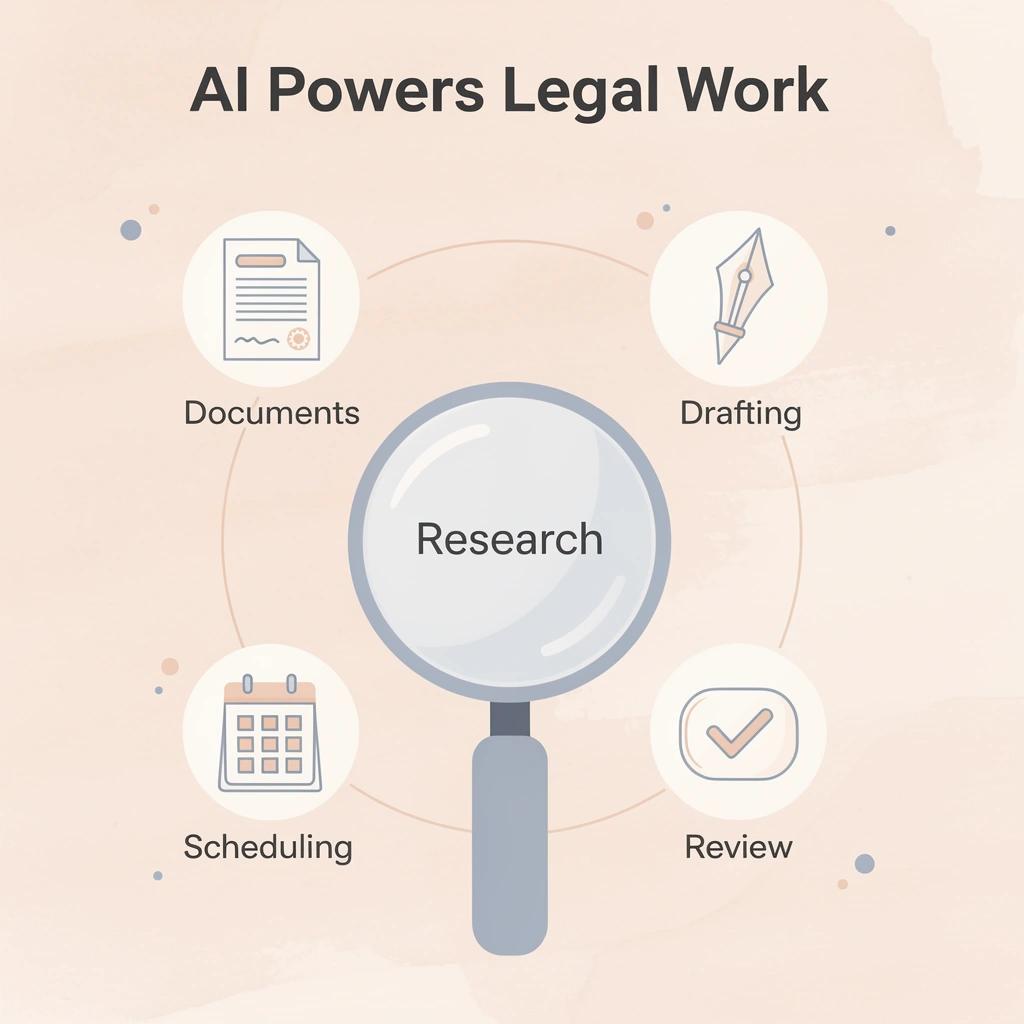
AI works best when it helps with everyday tasks that slow down legal teams. From legal research to document management, AI helps lawyers finish time-consuming tasks faster while keeping lawyers responsible for legal analysis, client advice, and final work product. Below are ten practical ways lawyers use AI to improve productivity.
"AI helps lawyers finish time-consuming tasks faster while keeping lawyers responsible for legal analysis, client advice, and final work product." — Core Principle of AI-Assisted Legal Practice
🎯 Key Point: AI is not a replacement for legal judgment — it's a force multiplier that frees lawyers to focus on high-value work that only they can do.
💡 Tip: The biggest productivity gains come from identifying your team's most repetitive, time-consuming tasks first — then targeting those with AI tools.
- Legal Research: AI accelerates discovery by surfacing relevant cases and statutes, allowing the lawyer to focus on analyzing and applying those findings to the case theory.
- Document Management: AI handles the heavy lifting of organizing, tagging, and retrieving files, leaving the lawyer to review and make final decisions on case strategy.
- Legal Analysis: AI identifies potential issues and drafts concise summaries, while the lawyer retains full responsibility for owning the final legal judgment.
- Client Advice: AI prepares the necessary background data and evidence, enabling the lawyer to focus on delivering personalized, empathetic counsel.
- Work Product: AI drafts and formats documents for speed and consistency, while the lawyer approves and finalizes the output to ensure professional quality.
🔑 Takeaway: The ten practical strategies below represent the most impactful areas where AI delivers measurable productivity improvements for modern legal teams — without compromising professional responsibility.
1. Streamline Legal Research
AI systems scan vast legal databases, statutes, and case law to identify relevant precedents and summaries in moments. Lawyers direct the process with clear questions, review summarised information, and build stronger arguments without spending days manually searching sources. This reduces missed authorities, accelerates case preparation, and enables deeper analysis of how rulings apply to unique client situations.
2. Accelerate Document Review Processes
AI sorts, extracts key clauses, and flags unclear points or risks across large document sets during discovery or due diligence. Professionals set parameters for relevance and privilege, then focus expertise on interpreting results and making strategic decisions. This yields fewer oversights, shorter review cycles, and the capacity to handle complex matters that would overwhelm manual teams.
3. Enhance Contract Drafting and Analysis
AI generates initial drafts from plain-language descriptions and highlights potential issues, such as ambiguous terms or non-standard provisions in existing agreements. Lawyers refine outputs for precision, incorporate jurisdiction-specific nuances, and negotiate from informed positions. This reduces drafting time from hours to minutes while maintaining full control over the final language.
4. Improve e-Discovery Efficiency
AI organizes electronic evidence, identifies patterns, and prioritizes materials most likely to matter in litigation. Attorneys define search criteria and relevance thresholds, then apply judgment to build compelling narratives from the curated set. Teams resolve cases faster, control costs, and present clearer arguments backed by comprehensive yet manageable data.
5. Support Predictive Case Analysis
AI examines historical outcomes, judicial trends, and related matters to outline likely scenarios and settlement ranges. Lawyers incorporate these insights into strategy sessions, advise clients with data-backed recommendations, and allocate resources more effectively. This strengthens negotiation leverage and sets realistic expectations.
6. Automate Routine Administrative Tasks
AI handles scheduling, billing entries, and basic client communications by processing instructions and generating accurate records. Lawyers oversee exceptions and maintain a personal touch in sensitive interactions while the system manages volume, freeing substantial time each week for substantive legal work and reducing administrative burnout.
7. Strengthen Litigation Strategy Development
AI reviews patterns in motions, judges behavior, and opposing counsel's approaches to suggest optimized tactics. Attorneys evaluate recommendations against case specifics, client objectives, and ethical considerations before implementation. This combination yields more proactive planning, better risk assessment, and higher success rates in complex disputes.
8. Facilitate Client Communication and Updates
AI drafts clear status reports and summarises case developments in accessible language for clients. Lawyers personalize content and address nuanced questions, ensuring transparency while managing high caseloads. Clients receive timely, professional updates that build trust and reduce unnecessary calls.
9. Optimize Knowledge Management Within the Firm
AI organizes internal precedents, memos, and expertise into searchable repositories that instantly retrieve relevant examples. Lawyers contribute insights and access tailored information for new matters, accelerating onboarding and ensuring consistency across teams. This institutional memory becomes more valuable over time and supports scalable growth in practice.
10. Enable Continuous Professional Development
AI curates personalized learning paths from legal updates, webinars, and emerging trends matched to individual practice areas. Lawyers review recommendations and engage with targeted content to stay ahead of regulatory changes, sustaining skill-building that keeps professionals competitive and equipped to handle evolving client needs.
How to Choose AI Tools That Support Legal Professionals
AI works best when it makes legal work stronger instead of creating problems. Before using any AI tool, lawyers should check whether it follows ethical rules, keeps confidential information safe, gives reliable results, and works well with their daily workflow.
"The most critical question a legal professional can ask about any AI tool is not what can it do — but can it be trusted to do it safely and ethically." — Legal Technology Best Practices
- Ethical Compliance: Guarantees the tool adheres to bar association mandates and professional conduct rules, ensuring that AI-assisted work meets all regulatory standards.
- Confidentiality & Data Security: Implements rigorous safeguards to shield sensitive client data, preventing breaches, unauthorized access, or misuse.
- Reliability of Results: Minimizes the risk of hallucinations or "black box" errors, ensuring research and drafting output is accurate, verifiable, and safe for client representation.
- Workflow Integration: Minimizes technical friction by embedding seamlessly into existing processes, saving time and preventing the disruption that comes with learning new, standalone platforms.
🎯 Key Point: Every AI tool used in a legal setting must be evaluated across all four of these criteria — skipping even one can expose a firm to serious professional and legal risk.
⚠️ Warning: Never adopt an AI tool based on features alone. A tool that lacks robust data confidentiality protections can violate attorney-client privilege — one of the most critical obligations in legal practice.

Assess Your Specific Practice Needs First
Map out your daily workflows to identify recurring tasks—such as research, document review, and contract analysis—that consume the most time. Consider your workload, practice areas, and team size to determine which features will benefit you most. This prevents spending on unused features and ensures the technology addresses your biggest challenges.
Prioritize Security and Confidentiality Protections
Ask for robust encryption, secure data handling, and clear policies on how information is stored and used for training. Verify that the provider complies with applicable regulations and has mechanisms in place to protect sensitive client information. Strong protections prevent data breaches and maintain the trust essential to legal work.
Verify Accuracy and Human Oversight Requirements
Pick solutions that explain their results clearly and require legal review before use. Test the tools on sample cases to assess their performance in your practice area and jurisdiction. Good systems flag uncertainty and support verification, keeping lawyers in control of accuracy and decision-making.
Evaluate Integration with Existing Systems
Pick tools that integrate smoothly with your existing case management, document storage, and billing platforms. When tools connect well, they reduce problems, eliminate duplicate data entry, and create unified workflows that save time. Compatibility ensures your team can adopt the tools with minimal retraining.
Examine Vendor Transparency and Support
Look for providers that openly share how they work, how often they update their tools, and their performance metrics. They should offer training tailored to your needs and ongoing support. Strong support helps your team maximize value and adapt as tools evolve.
Consider Ethical Compliance and Bias Mitigation
Ensure the tool follows professional conduct rules regarding competence, supervision, and client communication. Examine how the system addresses potential biases and maintains auditable decision records.
Test Real-World Performance Before Commitment
Ask for detailed demonstrations or pilot programs using your anonymized documents and scenarios. Measure time savings, accuracy, and ease of use with your team members. Practical testing reveals whether a solution improves productivity without introducing new risks or complexities.
How OpenCase Helps Lawyers Work Faster With Confidence
Working faster with confidence means solving two problems at the same time: speed without accuracy is just fast guessing, and accuracy without efficiency creates bottlenecks that burn lawyers out. The tools that move practices forward handle both simultaneously by eliminating friction that never needed to exist.
"Speed without accuracy is just fast guessing — the tools that move practices forward eliminate friction that never needed to exist."
🎯 Key Point: The most effective legal tools don't force a trade-off between speed and accuracy — they deliver both by removing unnecessary workflow friction.
💡 Tip: When evaluating any legal tech solution, ask whether it addresses both efficiency and precision — a tool that improves only one is only half a solution.
- Speed without accuracy: Fixes the danger of "fast but error-prone" work by embedding confidence checks directly into every stage of your workflow.
- Accuracy without efficiency: Resolves the "bottlenecks and burnout" caused by overly cautious processes by actively eliminating friction at every step.
- Both unaddressed: Tackles the "stalled practice growth" caused by operational inefficiencies through end-to-end workflow optimization, allowing your firm to scale effectively.

Why does accuracy matter as much as speed for lawyers?
Most AI tools create answers quickly from broad, unverified training data—until a judge asks for the citation and the source doesn't exist. According to the Federal Bar Association's Legal Industry Report 2025, 55% of legal professionals say that greater accuracy and confidence are key benefits of adopting legal tech. Lawyers who feel better about their work move faster with less doubt. In a profession where a single unsupported citation can unravel weeks of work, that difference matters enormously.
How does OpenCase remove the friction that slows legal work down?
Traditional legal research involves opening multiple database tabs, manually cross-referencing, and drafting in a separate application before reformatting it into a usable document. As caseloads grow and deadlines tighten, that fragmentation costs billable hours. OpenCase searches across 100+ legal databases trained on Cornell LII authoritative datasets, federal and state opinions, and official government archives, then delivers traceable, citation-backed answers inside tools attorneys already use: Microsoft Word, Google Docs, and Outlook. Research and drafting occur in the same environment, eliminating context switching that drains focus throughout the day.
What does verified sourcing actually change in practice?
The answer is: it changes what you're willing to sign your name to. Attorneys who rely on AI outputs without source traceability carry a quiet anxiety into every filing—a background awareness that something might not hold under scrutiny. When research is grounded in primary law records with full citation trails, that anxiety disappears. The Everlaw Blog reports that lawyers save up to 32.5 working days per year with generative AI. The practices capturing that gain aren't using AI recklessly; they're using it in ways they can defend, which means the technology has to show its work.
Why does security determine whether adoption actually sticks?
The pattern across global firms evaluating AI tools is consistent: the conversation starts with what the tool can do and ends with a discussion of following the rules. Attorneys want to know what happens to client data after it enters the platform. That concern is legitimate because keeping client information private is the foundation of the client relationship. Platforms that encrypt data in transit and at rest, maintain SOC 2 Type II compliance, and commit to never using client data for model training remove the compliance question entirely from the adoption decision. When security is settled, the conversation can return to what the tool helps attorneys accomplish.
The harder question isn't whether AI-powered legal research delivers value—the evidence is clear. It's whether the confidence it creates in individual attorneys translates into something the whole practice can build on.
Try our Legal AI to Support your Legal Work from Research to Final Draft
The legal profession rewards lawyers who use AI responsibly, with tools anchored to verified primary sources and built to support professional judgment rather than shortcut it. If your team switches between research platforms mid-draft, manually hunts for supporting authorities, or slows down on documents that should move faster, the cost is real: fewer hours on high-value work, slower client responses, and greater risk of missing critical authorities. OpenCase brings AI-powered legal research directly into Microsoft Word and Outlook, so attorneys surface verified case law and draft stronger arguments without leaving their working document.
"The cost is real: fewer hours on high-value work, slower client responses, and greater risk of missing critical authorities from inefficient research workflows." — OpenCase
💡 Tip: If your attorneys toggle between multiple research platforms and their drafting environment, you're paying for that friction in billable time and missed precedent.
🔑 Takeaway: AI-powered legal research embedded in Microsoft Word and Outlook eliminates the context-switching that slows every stage of the drafting process.

The result is a more focused workflow from research to final draft. Lawyers build arguments on authenticated sources and complete matters with greater confidence. Visit OpenCase to learn more or request a demo.
✅ Best Practice: Choose a legal AI tool that keeps attorneys inside their existing document environment — so verified case law, supporting authorities, and draft refinement all happen in one seamless flow.
- Legal Research: Eliminate tedious manual platform-switching by moving from siloed browser tabs to a workflow embedded directly into Word and Outlook.
- Source Verification: Bypass separate, manual authentication steps by having verified primary sources surfaced in-line while you work.
- Argument Drafting: Replace a disjointed and sluggish process with a seamless research-to-draft flow that keeps your focus on the argument.
- Client Response Time: Shift from delays caused by administrative inefficiency to a faster, more confident delivery that impresses clients and keeps cases moving.
Related Reading
- Best Ai Contract Review Tool
- Legora
- Harvey
- Spellbook
- ChatGPT For Lawyers
- Clio
- Ivo
- Everlaw
- Law Insider